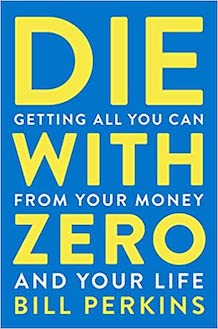
This is not a usual book for my blog even though the author had his first job as a screen clerk at the New York Mercantile Exchange, also working later on in the hedge fund space. I didn’t know the author was a trader when I got this book. The book is not about trading financial markets, but about trading your time for money. I consider the topic to be about psychology which is part of trading and living an enjoyable life overall. The title caught my attention and after watching a summary video I decided to get the book. It was published in 2020.
It challenges the conventional wisdom that successful entrepreneurs and investors often share with young people to help them make rational decisions with money in the future. We usually hear advice to spend less when young, save more for retirement and therefore grow assets over time so that they peak at the end of one’s lifetime. Bill Perkins gives a different perspective for enjoying life earlier, that grows the wealth of experiences when you’re still young and healthy. He says that an individual’s net worth should peak in their 50s-60s which would mean enjoying our lifetime much more.
Your life is the sum of your experiences
Friends call him an “honorary billionaire” that means he spends money like a billionaire while not being one. I think this idea is twofold, cause many people spend their hard earned money on jewelry, nice clothes and a luxury car to look like a millionaire while taking payday loans to provide it. That is not the same as Bill’s idea. He writes about the value of experiences compared to just things that feel good at first but depreciate in emotional value quickly. The author looks at “time is money” in a way that calculates the price of nice things in a store into time needed to earn it. It then makes him consider the value of something in his time not money. Meanwhile, he takes experiences in life as paying himself memory dividends. Bill suggests that investing in memories early on is better, because memory dividends add up just like financial investments do. And “early” is right now!
Don’t be afraid of running out of money
This is a fun one. The author describes how it’s a mental issue for the wealthy and poor, both. Most people who work everyday to save for retirement have the fear of running out of money at the back of their mind, even if they don’t deliberately think of it too often. It could be a mental challenge for traders who use trading profits to cover living expenses, especially at times of poor performance. I have put some thought to it myself and reached to a conclusion that life is a journey and it would be irrational to have monetary fears when there’s so many options available to make a living. Also, money should be seen as a tool not a goal. I want to enjoy my everyday life and spend as much money as I’m used to, no matter how good or bad the current performance. A profitable trading system needs some volatility to make money in the long-term. I have enough capital to go through drawdowns and still keep living the same lifestyle. Volatility is good! Embrace the drawdowns!
I disagree with the idea of spending everything when you’re young because you expect to earn more in the future. Furthermore, Bill makes a case for responsibly borrowing money to spend more while younger. I think it’s a bad idea and may lead a person into a debt spiral for the rest of the life. Even if one should live the moment and spend money on experiences, he or she should also create a habit of saving money for investing and the future. Finding the right balance is the key. The book didn’t change my capitalistic views on making money, but it definitely gave some balance to think more about enjoying the money made.
Die with Zero summary: the 9 rules
If you want the short version, the book is built around nine rules:
- Maximize your positive life experiences.
- Start investing in experiences early.
- Aim to die with zero.
- Use all available tools to help you die with zero.
- Give money to your children or to charity when it has the most impact.
- Don’t live your life on autopilot.
- Think of your life as distinct seasons.
- Know when to stop growing your wealth.
- Take your biggest risks when you have little to lose.
Rules 1–3 are the idea I described above: experiences pay memory dividends, so the earlier you buy them, the longer they pay. Rule 5 is about giving while it still makes a difference, not only through a will. Rule 9 is the one a trader recognizes at once. Small downside, big upside, and the time to take it is when a loss can’t sink you. My one disagreement stays the same: dying with zero is a target to plan toward, not a license to borrow for the fun part now.
Who is Bill Perkins?
Bill Perkins is the founder and principal of Skylar Capital Management, an energy-focused investment firm. He also co-founded SkyFi, a commercial satellite-imagery platform, and SynMax, an energy and maritime intelligence company, and he produces films. Houghton Mifflin Harcourt published Die with Zero in 2020, and according to his own site it has been translated into 25 languages.
I like the part about taking asymmetric risks where the downside is much less than the potential upside. This is the mindset of a trend-follower! There’s much more in this book about not delaying gratification, being bold and taking risks, planning life experiences, inheritance to children, leaving a real legacy, understanding age and health, planning medical expenses with insurance, and when to start spending more than you earn. All of it to live the best possible life filled with joy and experiences, and to die with zero.
Affiliate link: as an Amazon Associate I earn from qualifying purchases. It doesn’t change the verdict.