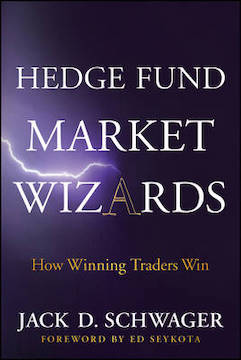
I have finished the fourth and last book of the Market Wizards series from Jack D. Schwager. It was published in 2012 and includes interviews with top traders on how winning traders win.
Ray Dalio, Colm O’Shea, Edward Thorp, Steve Clark, Jimmy Balodimas, Larry Benedict to name a few plus many other good traders and hedge fund managers are being interviewed by Jack Schwager. It’s a more modern era after the financial crisis of 2008 in the book which makes it an interesting read.
I took a lot of good nuggets from the book and want to share it with you:
- In bubbles it’s easier to get in early and ride it long til it starts to fall than to predict the top – it’s much harder to time the short side and once it starts to fall it can bounce heavily.
- Let go of what you feel about the market if your tools are saying something different.
- Don’t place stops by the book but place them where you think your thesis is wrong and you want to be out.
- Limit loss but not the gain. In longs can be done with call options where you can lose the premium but the gains are unlimited.
- If you trade instruments with less correlation the risk becomes smaller.
- Avoid gambler’s attitude, that is to cut losses and take trading as a process.
- Discretionary trader can reduce size after losses but a systematic trader would ruin opportunities with it and break the system.
- Even for a technical trader knowing some main fundamentals where the market could be heading to can create better opportunities.
- Analyse your past trades by segmenting winners and losers. Do what works and don’t do what doesn’t work. Do what your good at and don’t try various other things just because you were successful at your own thing.
- The larger the position, the more fear and emotions will affect the decision-making. Trade within your emotional capacity.
- If trading is going badly and in a losing streak, close everything and take a holiday. This will allow objectivity to come back into decision-making.
- Don’t watch every tick and be tied to screens, it will make you liquidate positions prematurely.
- Your job as a trader is to protect the direction of the equity line.
- Work out on your own methodology and system. You will never use someone’s system as well as the original author cause you are not them.
Who is in Hedge Fund Market Wizards?
Wiley published the book in May 2012, with a foreword by Ed Seykota. It has fifteen interviews in three parts: Macro Men (chapters 1–5), Multistrategy Players (6–8) and Equity Traders (9–15), and it ends with a chapter of 40 Market Wizard lessons. Here is the line-up in book order, with Schwager’s chapter titles:
| Trader | Chapter title |
|---|---|
| Colm O’Shea | Knowing When It’s Raining |
| Ray Dalio | The Man Who Loves Mistakes |
| Larry Benedict | Beyond Three Strikes |
| Scott Ramsey | Low-Risk Futures Trader |
| Jaffray Woodriff | The Third Way |
| Edward Thorp | The Innovator |
| Jamie Mai | Seeking Asymmetry |
| Michael Platt | The Art and Science of Risk Control |
| Steve Clark | Do More of What Works and Less of What Doesn’t |
| Martin Taylor | The Tsar Has No Clothes |
| Tom Claugus | A Change of Plans |
| Joe Vidich | Harvesting Losses |
| Kevin Daly | Who Is Warren Buffett? |
| Jimmy Balodimas | Stepping in Front of Freight Trains |
| Joel Greenblatt | The Magic Formula |
Steve Clark’s chapter title is almost word for word the takeaway in my list about segmenting winners and losers. Ray Dalio later wrote his own rules down in a book, and my review of Principles covers it.
Colm O’Shea’s stop: where the idea is wrong
The takeaway about stops comes from the first chapter. Schwager writes that O’Shea treats each trade idea as a hypothesis and is wrong on at least half of his trades. He decides before the trade at what price the hypothesis is proven wrong, and he sizes the position so that a move to that price costs only a small percentage of assets. That is why, as Schwager puts it, he has no good war stories about trades gone wrong.
Here is the arithmetic with made-up round numbers. A $100,000 account risks 0.5% on an idea, so $500. The idea is wrong if the market trades below $48, and the entry is $50. That is $2 of risk per share, so the position is 250 shares. If the stop is $5 away instead, the position is 100 shares, and the loss is still $500. The stop comes from the idea and the size comes from the stop, which is the method I use as well. My post on where to put the stop and how much to buy works through it on a real chart.
Is there a fifth Market Wizards book?
When I wrote this review it was the last one. Eight years after this book, Schwager published Unknown Market Wizards (2020), about individual traders nobody had heard of, and I reviewed it too: Unknown Market Wizards review.
I hope you find my takeaways useful and I also recommend to read the whole book as each person can find different insights to be educational.
Affiliate link: as an Amazon Associate I earn from qualifying purchases. It doesn’t change the verdict.