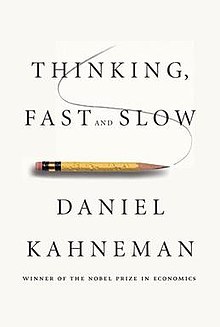
Another great book on psychology. Thinking, Fast and Slow by Daniel Kahneman reflects his thorough life work on human behavior and psychology. Tho it’s mostly about the topics in general, it also includes facts about trading psychology.
Some of the keywords from this book are attention and effort, laziness, cognitive ease, surprises and causes, judgements, the law of small numbers, regression to the mean, the illusion of understanding, intuitions vs formulas, prospect theory, rare events, life as a story.
Key lessons I learned from this book:
- There are two systems in our mind, 1 is fast and intuitive for easy tasks, 2 takes more effort and is used for more complex tasks.
- “What you see is all there is” – a cognitive bias that shows how irrational people are. People jump to conclusions based on their biases, past experience, thoughts nothing to do with reality.
- People are generally optimistic about their ventures that is a biased feeling. Stock picking is most of the times random and so are the results, creating illusions of skills.
- People are generally risk averse with gains and risk seeking with losses (should be the other way round in trading), on average investors shouldn’t trust their intuition, and studies show they think of crisis and negative events more often than necessary.
- If you can choose between intuition VS formula for a complex task, you should choose formula. Base rates often create illusions and make us jump to conclusions, but additional facts may change the meaning (from base rate) completely.
- The halo effect – if you like a politician’s politics, you will probably like the person, too, just because of his/her political views.
- Regression to the mean is a situation where someone has done extremely well and if it’s much based on luck, it will probably be temporary and come back down to the mean.
- Overall, the mind can trick you and play games that are counter productive to your goals. If there is a complex task you should slow down and let your system 2 involve to make better decisions than to let system 1 jump to intuitive bets.
Thinking, Fast and Slow summary
The book came out in 2011 with Farrar, Straus and Giroux and is split into five parts. Part 1 introduces the two systems: System 1 is fast, automatic and intuitive, System 2 is slow, effortful and lazy. Part 2 covers heuristics and biases, the mental shortcuts System 1 takes, from anchoring to the law of small numbers. Part 3 is about overconfidence and the illusion of understanding. Part 4, Choices, is prospect theory and loss aversion. Part 5 separates the experiencing self from the remembering self.
For a trader, parts 3 and 4 are the ones to read twice. Part 3 explains why a good run feels like skill, and part 4 explains why a losing position is so hard to close.
Loss aversion: the chapter every trader should read
Kahneman writes that the loss aversion ratio has been estimated in several experiments and is usually between 1.5 and 2.5. In plain terms, losing $100 hurts about as much as winning $150 to $250 feels good. So with a ratio of 2, a 50/50 bet has to offer about $200 against a $100 loss before it even feels fair.
In trading the same bias shows up as what the book calls the disposition effect: investors are much keener to sell winners, and end on a positive note, than to sell losers. So the winners get cut early and the losers get time to grow. That is exactly backwards for a trader, and it is why I put the stop in before the trade, when System 2 is still in charge. I wrote about how in where to put the stop and how much to buy.
What hasn’t held up: the priming chapter
Not everything in the book survived. In 2017 Ulrich Schimmack and colleagues published an analysis called “Reconstruction of a Train Wreck: How Priming Research Went off the Rails”, which looked at the studies behind chapter 4, on priming, and found them statistically very weak. Kahneman replied in the comments and accepted the criticism. He wrote that he had placed too much faith in underpowered studies.
The irony is that the law of small numbers, trusting results from small samples, is one of the biases the book itself warns about. I take two things from that. The core of the book, the two systems, overconfidence and prospect theory, rests on far more evidence than the priming chapter. And a backtest with 15 trades is a small sample too, however good the equity curve looks.
Who was Daniel Kahneman?
Daniel Kahneman was a psychologist who won the 2002 Nobel Memorial Prize in Economic Sciences for bringing insights from psychology into economics, especially about judgment and decision-making under uncertainty. Much of that work was done with Amos Tversky, with whom he started working in 1969, and it helped launch behavioral economics. He was a professor emeritus of psychology and public affairs at Princeton and received the Presidential Medal of Freedom in 2013. He died on 27 March 2024, aged 90, about four and a half years after I wrote this review.
A good book and I suggest you read it regardless of your profession and daily activities. To me the book was an eye opener how the brain can work against you.
Affiliate link: as an Amazon Associate I earn from qualifying purchases. It doesn’t change the verdict.