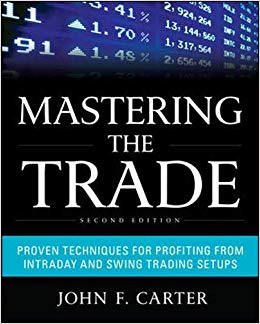
A fellow trader recommended this book to me. John F. Carter is a trader, author and educator from the US. I will write a bit about the book and what I think of it.
John Carter first starts the book with his own life experience, how he wanted to become a trader and paid a high tuition fee at first. He sums up all the emotions involved in financial trading pretty well and with a sense of humor. He describes own experience how he wanted to use a little bit of family’s money, just to secretly borrow it for a short period of time to say, to win some more money in the stock market and then “put it back”. You might already be guessing how this venture ended for him.. 😉
Anyway, after the first hustle and bustle, at some point he managed to start making money in the markets and decided to stay around longer. He is now a professional trader and I follow him on Twitter, much great insights from time to time. He’s also been on some trading podcasts talking about one of his most successful trades, shorting TSLA somewhere in 2014 I think.
In his book Mastering the Trade, John covers topics about what makes markets move, psychology among market participants, trader mindset, fears, predictions; but also shares some of his proven techniques for profiting from day-trading and swing trading. I never take any trading methods from a book or a blog to start trading them blindly, but it give ideas to take notes on and backtest your own approach to it.
One interesting strategy the author presents is trading the opening gap. As the Wall Street saying goes: “Amateurs make the openings, pros make the closings.” It means retail investors and non-professional traders place their orders before going to work, but the pros in Wall Street are there for the whole day taking advantage of the intraday moves. So there’s often morning panic, either positive or negative, and John’s method shows how to fade this in the other direction, also referred to as “gap fill”. A lot of the price gaps at the open often get filled during the day or the next, so there’s opportunity to build a trading system around it.
I’m usually skeptical about trading methods publicly available in a book or a blog as it wouldn’t make sense to publish your edge if you want to be using it. So it always rises questions for me if it’s still working for the author. One of the indicators John Carter presents in his book is the $TICK which measures how many stocks at the moment are going up or down. I’ve heard some traders on podcasts saying it doesn’t work anymore as it used to due to HFT (High-Frequency Trading) and the algorithms taking over most of the intraday game.
Who is John Carter?
John F. Carter has been a full-time trader since 1996 and is the founder of Simpler Trading, a trading education company. According to his Simpler Trading bio it started in 1999 as TradeTheMarkets.com, a site where he posted his own trade ideas. He is best known for his own indicator, the Squeeze, which he uses to get into a trade before a big move. Mastering the Trade is now in its third edition (McGraw-Hill, late 2018), which added market internals such as the VIX, a pre-market checklist and scanning methods.
Do opening gaps really fill? I checked
The gap play in the book rests on the idea I mentioned above: a lot of opening gaps get filled the same day or the next. I tested it on SPY, the S&P 500 ETF, with daily prices from Yahoo Finance from January 2014 to 15 October 2026. A gap is an open above or below the previous close, and it counts as filled when the price trades back to that close.
| Gap size | Days | Same day | By next day |
|---|---|---|---|
| Under 0.25% | 45% | 82% | 88% |
| 0.25–0.5% | 27% | 57% | 70% |
| 0.5–1% | 19% | 35% | 52% |
| Over 1% | 9% | 28% | 42% |
| All gaps | 100% | 62% | 72% |
So the saying holds, mostly for the small stuff. Of 3,184 gaps, 62% were filled the same day and 72% by the end of the next one. But almost half of all gaps were smaller than a quarter of a percent, and those fill four times out of five almost by accident: the price only has to move back a dollar or two. The big gaps, the ones that look like morning panic, are the ones that tend to keep going. Over 1%, only 28% were filled the same day. I asked the same question about three-candle gaps in my fair value gap test.
A fill rate is not a profit either. Someone who sells a gap up at the open is short on the 40% of gap-up days that didn’t fill, and those include the trend days that run all day. That is where the stop and the position size come in (more in my stop loss post). And it is why I still think what I thought in 2019: test a published setup yourself before you trust it. I used SPY rather than the index itself because the index’s first print of the day sits closer to the previous close (median gap 0.17% against 0.28% for SPY over the same days). Prices are not adjusted for dividends; leaving out the 51 ex-dividend days changes the totals by less than half a point.
Not financial advice. This is educational content, shared for information and entertainment only, and it is not a recommendation to buy or sell any asset. Backtests and past results do not guarantee future results, and the numbers or charts here may contain mistakes. Trading carries risk, including losing all the money you put in. Do your own research before you make any decision.
Overall I liked the book and it was a good read to understand how John F. Carter thinks about the markets.
Affiliate link: as an Amazon Associate I earn from qualifying purchases. It doesn’t change the verdict.