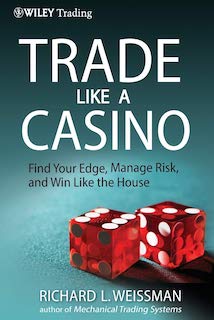
I had this book in my reading list for a long time after seeing several recommendations online. The title looked interesting due to the fact I had read from different sources how poker and odds of many casino games also apply to trading. The summary revealed some good and original points that made the impression of the book being somewhat unique. It was published in 2011.
What does “trade like a casino” mean?
A casino doesn’t know who wins the next spin, and it doesn’t care. It knows its edge. On a single-zero roulette wheel there are 37 pockets, 18 of them red. A $10 bet on red wins $10 with 18 chances in 37 and loses $10 with 19 chances in 37, so the player loses about 2.7% of every bet on average and the house wins it. Over 10,000 such bets the house expects to keep around $2,700, whatever happens on any single spin. The table limit makes sure no single player can hurt it badly before the numbers play out.
Trading like a casino means the same three things. First, a model with a positive expectancy: say you win 40% of your trades, your winners make 2R and your losers lose 1R (R is the money you risk per trade). The expectancy is 0.4 × 2 − 0.6 × 1 = +0.2R per trade, even though you lose more often than you win. Second, a table limit: a small, fixed risk per trade, so a run of losers can’t end the game. Third, enough trades for the edge to show, taken without second-guessing. Weissman’s book is about all three, and mostly about the third.
Human nature makes it hard
Weissman starts off the book with market inefficiencies, technical analysis, how price has memory and why volatility matters. His saying “If it feels good, don’t do it.” makes total sense to me as I have entered my best trades when the execution felt terrible. Discomfort leads to profits, comfort leads to losses. The author brings up some work done by Daniel Kahneman and Amos Tversky on human psychology that I have also previously written about in my blog – most people are risk-averse with gains and risk-seeking with losses which makes profitable trading hard.
Why bet size matters
In the chapter about risk management, there’s a good analogy of a trader’s bet size to the table limits at casinos. A casino knows that even if a single spin at the roulette table can result in a loss for the company, the more spins are run the more money the casino makes in the long run by exploiting its edge. Therefore they need to limit a single bet at the table so a player would make many smaller bets. Also, the casino doesn’t need to know which bet is going to work for them. Let that sink in as a trader.
The moment of now
While we don’t know what happens next, according to Richard we do know that volatility comes in cycles. There are many educational lessons in the book like pitfalls in trading the money instead of the market and why it matters to let profits run. The author emphasizes how to minimize trader regret with partial profits and adjusting stop loss. Many good takeaways on timeframe analysis, and several trading system examples of both trend-following and mean reversion. More on patience and discipline with positive expectancy trading models. “Always trade value, never trade price.” felt misleading to me at first, but I understand his point – the author doesn’t refer to value as most investors would but he means a trader should not care for specific number as the price and therefore not try to decide if that particular price is low or high, but to put that price in some technical value perspective instead. “Don’t anticipate, just participate.” is a good quote to describe the unnecessary need for future predictions, which should be replaced by reacting to the moment of now.
Psychological stages in trading
Third part of the book is about trader psychology. He writes about the stages for a trader to accept uncertainty and taking losses: denial, anger, bargaining, depression, acceptance. He goes on describing the six destructive emotions and how to deal with them: pride, jealousy, attachment, ignorance, greed, aversion. There’s an incredibly detailed and useful questionnaire for traders to think through each aspect of their business. This due diligence questionnaire includes topics about trading style, performance record, methodologies, risk management, execution, research and development.
Who is Richard Weissman?
Richard L. Weissman is a trader, trading system developer and educator on trading and risk management. He is a former member and trader at the New York Futures Exchange and teaches professionals as a senior associate with the Energy Management Institute, according to his Wiley author page. That background shows in the book: it reads like someone who has taught risk to traders who have to report it.
Book details
The full title is Trade Like a Casino: Find Your Edge, Manage Risk, and Win Like the House. It came out in the Wiley Trading series in 2011, 288 pages in hardcover (ISBN 978-0-470-93309-1). Its twelve chapters run from developing positive expectancy models, price risk management and unwavering discipline, through the cyclical nature of volatility, trading the markets and not the money, minimizing trader regret and timeframe analysis, to using trading models, anticipating the signal, common pitfalls, analyzing performance and becoming an even-tempered trader.
Understanding the casino paradigm
It is often the transition from beginner to intermediate-level trader when the speculator is able to accept the casino paradigm: take opportunities and have no fear of losses while applying rigid risk management to see “what happens”. It takes intuitive skills from experience that turn an intermediate trader to advanced level. Master traders know why practicing the casino paradigm is essential. This is what the book is about. It is a good book about finding a positive expectancy trading model but even more importantly on how to be able to implement and stick to it. After getting edge in the market with proper risk management, psychology becomes critical to succeed long-term.
Affiliate link: as an Amazon Associate I earn from qualifying purchases. It doesn’t change the verdict.