Yes, the US stock market is open on Black Friday, but only for half a day. On Friday 27 November 2026 the NYSE and Nasdaq close early at 1:00 p.m. Eastern, and on Thanksgiving Day, Thursday 26 November, they are closed. I also looked at every Black Friday since 1950: the S&P 500 rose on 54 of 76, far more often than on an ordinary day. Over the last 20 years, though, it rose on only 10.
Is the stock market open on Black Friday?
It is, with shorter hours. The NYSE’s holiday calendar says each of its markets will close early at 1:00 p.m. (1:15 p.m. for eligible options) on Friday, 27 November 2026. Nasdaq’s schedule is the same: closed on Thanksgiving, closing at 1:00 p.m. on Black Friday. The session still opens at the usual 9:30 a.m., so you get three and a half hours of trading instead of six and a half.
| Day (2026) | US stock market |
|---|---|
| Thu 26 Nov, Thanksgiving | Closed |
| Fri 27 Nov, Black Friday | 9:30 a.m. to 1:00 p.m. ET |
| Thu 24 Dec, Christmas Eve | 9:30 a.m. to 1:00 p.m. ET |
| Fri 25 Dec, Christmas Day | Closed |
Thanksgiving itself is one of the full market holidays, like Christmas Day. There is no trading on the exchanges at all that Thursday.
What the S&P 500 did on every Black Friday since 1950
The half day has a reputation for being a good one. So I took the S&P 500’s daily closes from Yahoo Finance, found every Black Friday from 1950 to 2025, and compared its close with the close on the Wednesday before Thanksgiving. From 1975 on, I checked every one of those returns against Cboe’s own S&P 500 history, and they matched.
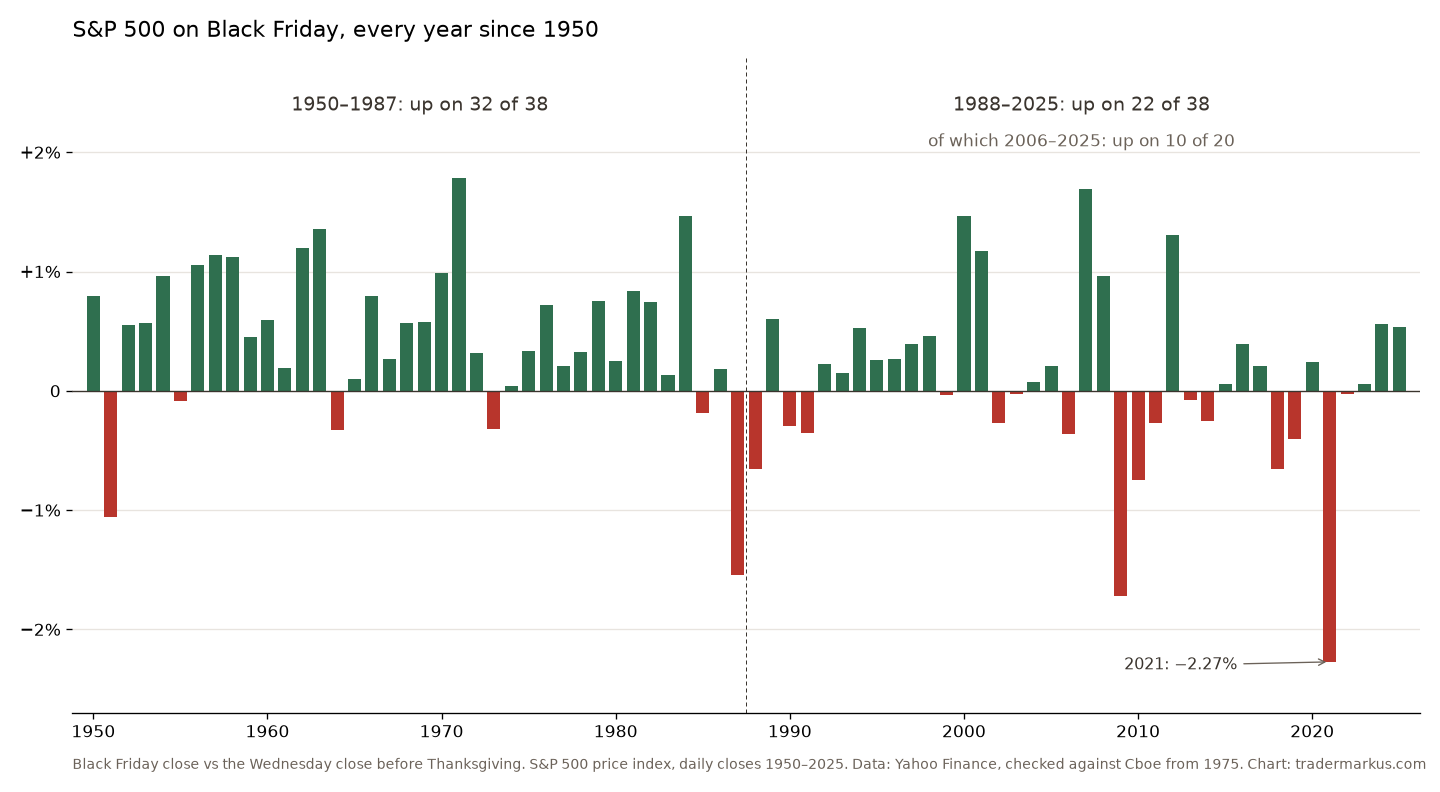
Over all 76 years, the index closed higher on 54 Black Fridays, or 71% of them. An ordinary day since 1950 was up 53% of the time. The average Black Friday gained 0.28%, against 0.04% for any day. The best was 1971 with +1.78%. The worst was 2021, when the index fell 2.27% on 26 November, the day the World Health Organization declared a new Covid variant, Omicron, a variant of concern.
But look at the two halves of the chart.
| Black Friday | Up | Average |
|---|---|---|
| 1950–1987 | 32 of 38 | +0.47% |
| 1988–2025 | 22 of 38 | +0.09% |
| 2006–2025 | 10 of 20 | −0.04% |
Up to 1987 the day was almost a sure thing. Since 2006 it has been a coin flip, and the average is slightly negative. I can’t prove why. A pattern anyone can find in a calendar is easy to trade, and enough people trading it can wear it down. Whatever the reason, the old statistic that gets repeated every November describes a market that no longer behaves that way.
The whole Thanksgiving week
The week holds up better than the day. From the close on the Friday before Thanksgiving to the close on Black Friday, the S&P 500 rose in 53 of 76 years, 70% of them, with a median gain of 0.87%. An ordinary Friday-to-Friday week was up 57% of the time with a median of 0.30%, and that is with one more trading day in it. From 2006 to 2025 the Thanksgiving week was still up in 14 of 20 years.
The day before the holiday was even better than Black Friday: the Wednesday rose in 58 of 76 years. The Monday after was the weak spot. From the Black Friday close to the Monday close, the index rose in only 29 of 76 years, 38% of them, with an average loss of 0.29%. Part of the week’s gain tended to come back after the weekend.
How I treat Black Friday as a trader
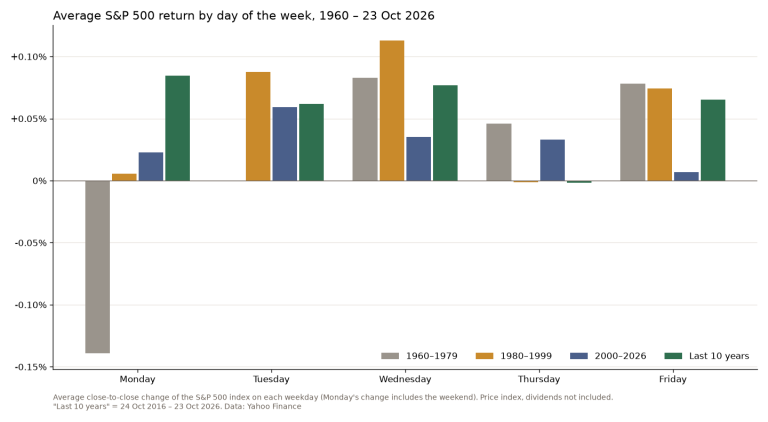
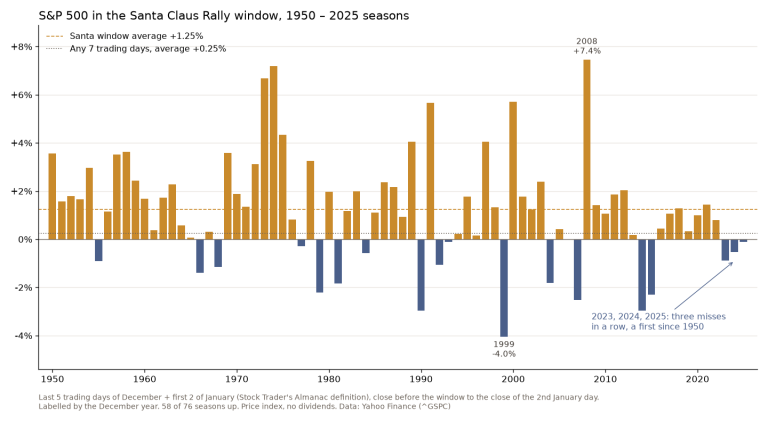
I don’t trade the calendar. Seventy-six data points sounds like a lot, but it is one day a year, and the last twenty years say the edge on the day itself is gone. The same thing happened with the weekday: in my test of the best day of the week to buy stocks, Monday was the worst day in the 1960s and 1970s and the best in the last 10 years. Calendar edges tend to fade once everyone knows about them, as the S&P 500’s rise on Fed decision days did after 2011. The Santa Claus rally a month later is still there, but it is less than half the size it was in the 1950s to the 1970s.
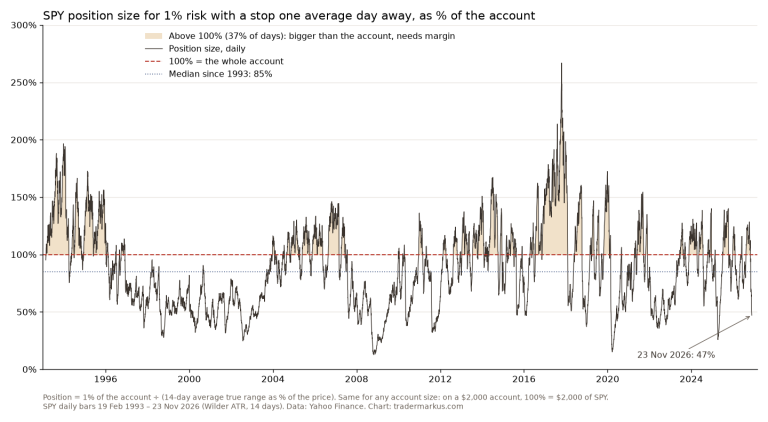
The half day matters more for practical reasons. The session ends at 1:00 p.m., so a stop or a plan that assumes a normal close at 4:00 p.m. needs a look. If I hold a position over the long weekend, I size it for the gap that can come on Monday, the day that has been weak more often than not.
FAQ
Is the stock market open the Friday after Thanksgiving?
Yes. In 2026 the NYSE and Nasdaq are open on Friday 27 November from 9:30 a.m. to an early close at 1:00 p.m. Eastern.
Is the stock market open on Thanksgiving?
No. US stock exchanges are closed on Thanksgiving Day, which in 2026 is Thursday 26 November.
Does the stock market go up on Black Friday?
Usually, over the long run: the S&P 500 rose on 54 of 76 Black Fridays from 1950 to 2025. But from 2006 to 2025 it rose on only 10 of 20, with an average of −0.04%.
How did the stock market do on Black Friday 2025?
The S&P 500 rose 0.54% on Friday 28 November 2025, and 3.73% over the whole Thanksgiving week.
Black Friday is a short day with a good old record and an ordinary recent one. Know when the market closes, and don’t expect the calendar to do the work.
Not financial advice. This is educational content, shared for information and entertainment only, and it is not a recommendation to buy or sell any asset. Backtests and past results do not guarantee future results, and the numbers or charts here may contain mistakes. Trading carries risk, including losing all the money you put in. Do your own research before you make any decision.