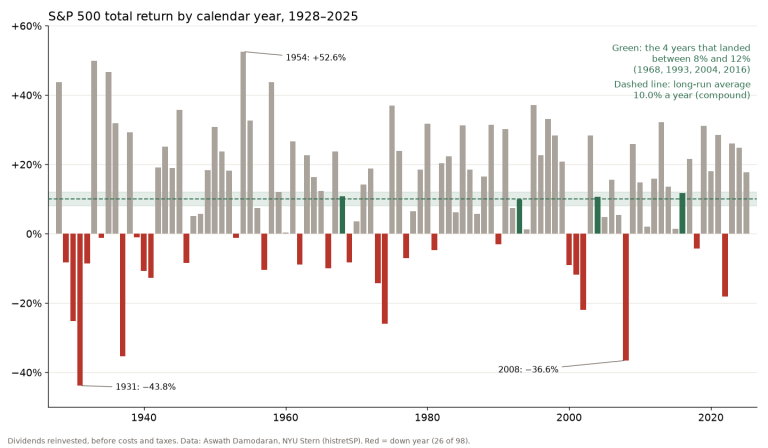
The rule of 72 says you can find how many years an investment takes to double by dividing 72 by its yearly return: at 8% that is 9 years, at 10% about 7.2. As arithmetic it is very good, within 1% of the exact answer for any return from 6% to 10%. As a forecast for the stock market it is much rougher. The S&P 500 has returned 10.0% a year with dividends since 1928, so the rule says 7.2 years, but the real doubling time from the start of each year ran from 2 years to 22.
What is the rule of 72?
It’s a shortcut for compound growth. Take the annual return in percent, divide 72 by it, and the answer is roughly how many years it takes for the money to double. At 6% a year that is 72 ÷ 6 = 12 years. At 9% it is 8. It works the other way round too: if you want to double your money in 6 years, you need about 72 ÷ 6 = 12% a year.
The rule is old. According to its Wikipedia entry, an early reference is in Luca Pacioli’s Summa de arithmetica, printed in Venice in 1494, where he uses it to estimate the doubling time of an investment without explaining where it comes from. The number 72 survives because it divides cleanly by 2, 3, 4, 6, 8, 9 and 12, which made it easy to use in your head long before anyone carried a calculator.
The rule of 72 formula: how accurate is it?
The exact doubling time is ln(2) ÷ ln(1 + r), where r is the return as a decimal. The rule replaces that with 72 ÷ the return in percent. I worked out both for common returns:
| Return | Exact years | Rule of 72 |
|---|---|---|
| 2% | 35.00 | 36.00 |
| 4% | 17.67 | 18.00 |
| 6% | 11.90 | 12.00 |
| 8% | 9.01 | 9.00 |
| 10% | 7.27 | 7.20 |
| 12% | 6.12 | 6.00 |
| 15% | 4.96 | 4.80 |
| 20% | 3.80 | 3.60 |
Around 8% it is almost perfect. Below that it slightly overestimates the time, above it the rule gets a little too optimistic: at 20% it says 3.6 years when the real answer is 3.8. For continuous compounding, or very low rates, 69.3 or 70 is the more accurate number, and for high rates 78 works better. For the returns most investors deal with, 72 is fine. The formula is never the weak part.
Does the rule of 72 work for stocks?
The weak part is the return you put into it. The rule assumes the same return every year, and the stock market doesn’t do that. To see how much it matters, I took the S&P 500’s yearly total returns with dividends reinvested from 1928 to 2025 (Aswath Damodaran’s dataset at NYU Stern) and, for every start year, counted how many calendar years $1 needed to become $2.
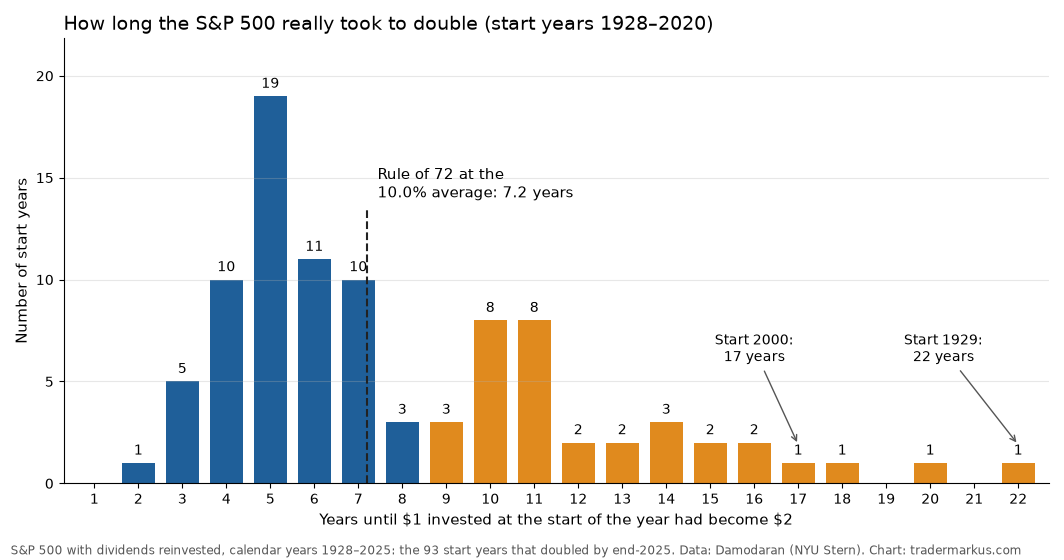
The average return over the whole period was 10.02% a year, so the rule says 7.2 years. The median of the 93 start years that have doubled so far was 7 years, so on average the rule is right. The spread is the problem. Money invested at the start of 1954 had doubled after 2 years. Money invested at the start of 1929 needed 22, and money invested at the start of 2000 needed 17. Only 59 of the 93 start years doubled within 8 years, which is 63%. Another 13 took 13 years or longer. The five start years from 2021 to 2025 haven’t doubled yet by the end of 2025.
It gets more uneven with daily data. On the S&P 500 total return index from January 1988 to 20 November 2026, the average was 11.14% a year, so the rule says 6.5 years. The median doubling time over 8,637 start days was 5.3 years. Only 15.1% of start days doubled within a year either side of the rule, and 24.9% took more than three years longer than it. The fastest double started on 23 March 2020 and was done by 12 July 2021, in 1.3 years. The slowest started on 23 March 2000 and took until 25 November 2016, 16.7 years.
After inflation the numbers stretch. The S&P 500’s real return was 6.78% a year from 1928 to 2025, so the rule says 10.6 years for your purchasing power to double. The median was 9 years and the longest 24, for money invested in 1929, 1962 or 1965.
Rule of 72 for bonds, cash and gold
Smoother assets don’t make it much tidier. On the same data, 3-month Treasury bills returned 3.37% a year, so the rule says 21.4 years, and the median actual doubling time was 18 years. 10-year Treasury bonds made 4.53%, rule 15.9 years, median 17. Gold made 5.61%, rule 12.8 years, median 14, but the range runs from 1 year (from the start of 1979) to 44 years (from 1928, when the gold price was still fixed by the government). Whatever the asset, the rule tells you the typical time. It can’t tell you which kind of decade you are starting in.
What fees and inflation do to the rule of 72
This is where I find the rule most useful, because costs come straight off the return. At 10% a year your money doubles in about 7.2 years. Pay a 1% fee and it becomes 9%, so 8 years. That sounds small, but over 30 years $10,000 grows to $174,494 at 10% and to $132,677 at 9%. A 2% fee takes it down to $100,627, more than 40% less money for the same market.
The rule works on inflation too. US consumer prices rose 3.04% a year on average from 1928 to 2025, which by the rule means prices double about every 24 years. Cash under the mattress loses half its buying power in roughly the same time a 3% bond needs to double it. I also like it as a check on trading claims. Someone who says they make 5% a month is saying their account doubles every 14 months. Keep that up for ten years and $10,000 becomes several million dollars. If it really worked, they wouldn’t need to sell you a course.
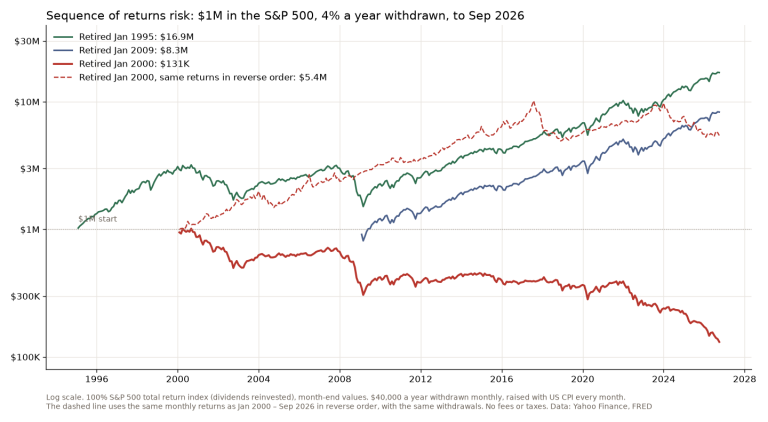
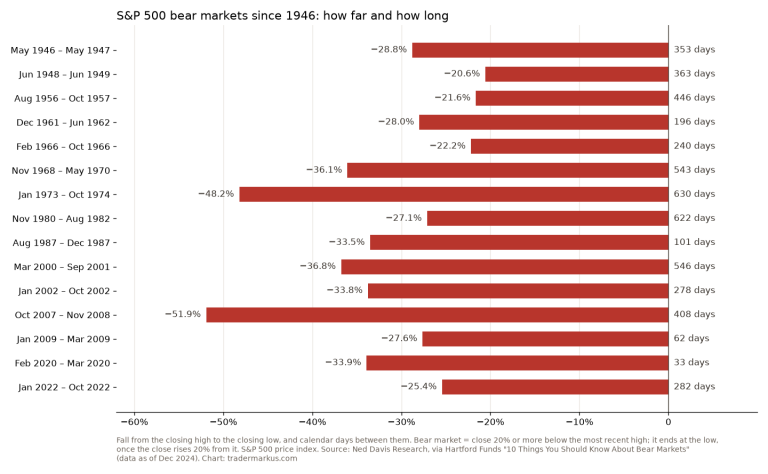
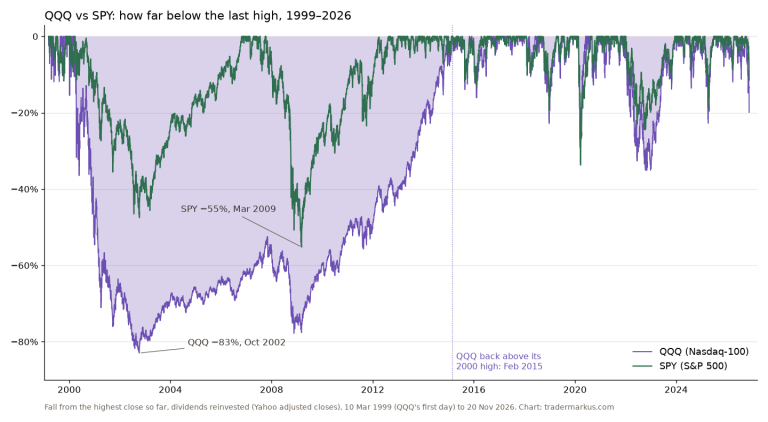
It also works backwards, which the rule doesn’t show. A fall of 50% needs +100% to get back, so a bear market can cost you a full doubling period. I wrote about that side in compounding is the eighth wonder of the world, and about how deep and long the S&P 500’s falls have been in max drawdown.
How I use the rule of 72
As a quick sense check, not as a plan. It tells you very fast whether a return is worth anything over a lifetime: 4% doubles in about 18 years, 10% in about 7, and that difference is most of what 98 years of S&P 500 returns show. What it won’t tell you is when. If your plan needs your money to double within the next 8 years, the S&P 500’s history gives you roughly a two-in-three chance, and the other third is where people sell at the bottom. That is also why I like the Wealth Equation in The Millionaire Next Door more as a mirror than as a target.
FAQ
How long does it take to double money at 10%?
About 7.2 years by the rule of 72, 7.27 years exactly. On the S&P 500, which averaged close to 10% a year with dividends since 1928, the real answer from the start of a year ran from 2 years to 22 years, with a median of 7.
Is the rule of 72 accurate?
The math is. For returns between 6% and 10% it is within 1% of the exact doubling time, and even at 20% it is off by only about 0.2 years. What is inaccurate is assuming a steady return: real markets give you the average only over long periods, in a very uneven order.
Does the rule of 72 include inflation?
No. It doubles whatever number you give it. Use the return after inflation if you want to know when your purchasing power doubles. For the S&P 500 since 1928 that is 6.78% a year, so about 10.6 years instead of 7.2.
Does the rule of 72 work for monthly returns?
Yes. Divide 72 by the monthly return and you get months. 2% a month doubles in about 36 months. It is a useful way to see how unrealistic many trading promises are.
The rule of 72 is a good calculator and a bad fortune teller. Use it to compare returns, fees and inflation, and leave room in your plans for the years when doubling takes three times as long.
Not financial advice. This is educational content, shared for information and entertainment only, and it is not a recommendation to buy or sell any asset. Backtests and past results do not guarantee future results, and the numbers or charts here may contain mistakes. Trading carries risk, including losing all the money you put in. Do your own research before you make any decision.