The Millionaire Next Door is a 1996 study of how ordinary Americans became millionaires, and its answer is boring on purpose: they earned a decent income, spent well below it and invested the difference for decades. Most of them don’t look rich. For a trader, the useful part is the difference the authors draw between a high income and actual wealth, because a trading account can fool you in exactly the same way.
Thomas J. Stanley was a marketing professor who spent his career surveying wealthy households, and William D. Danko was his co-author. The book was first published by Longstreet Press in 1996 and became a New York Times best seller. Stanley died in 2015. The edition I link below is the 20th anniversary edition from 2016, 272 pages, with a foreword by his daughter, Sarah Stanley Fallaw, who later wrote the follow-up, The Next Millionaire Next Door, with material he had started.
The Millionaire Next Door summary
The authors went looking for millionaires expecting to find them in expensive neighborhoods, and mostly didn’t. The households with real net worth were more often in middle-class and blue-collar areas, buying used cars and paying a small share of their wealth in income tax. Their children often didn’t know how much the family had until they were adults. Meanwhile many high-income professionals had surprisingly little left over, because they spent their income on looking successful.
That split is the core of the book. Stanley and Danko call the first group Prodigious Accumulators of Wealth (PAWs) and the second Under Accumulators of Wealth (UAWs). Another way they put it is balance sheet affluent versus income statement affluent: one group is rich on paper, the other only earns like it. The rest of the book is about the habits that separate the two, from car buying to how parents hand money to their adult children.
What are the 7 traits of The Millionaire Next Door?
The book lists seven traits that kept showing up among the people who had built wealth. In short:
- They live well below their means.
- They spend their time, energy and money in ways that build wealth.
- They care more about financial independence than about showing off social status.
- Their parents didn’t support them with regular gifts of money, what the authors call economic outpatient care.
- Their adult children are economically self-sufficient.
- They are good at spotting market opportunities.
- They chose the right occupation.
The first one carries most of the weight. Everything after it is either a way to make it possible or a consequence of doing it for long enough.
The Millionaire Next Door formula
The best-known tool in the book is a rule of thumb Stanley called the Wealth Equation: multiply your age by your household’s annual pre-tax income, divide by ten, and that is roughly what your net worth should be, not counting inheritances. A 50-year-old earning $250,000 a year “should” be worth $1.25 million. A 40-year-old household earning $100,000 should be worth about $400,000. If you are worth twice the expected figure or more, you are a PAW. Well below it, a UAW.
Stanley himself added two warnings on his blog. The equation came from national surveys of households earning $80,000 or more, and the typical millionaire in his surveys was in his or her late 50s, so it overstates what someone in their 20s or 30s should have. He suggested subtracting the years you weren’t working full time, for example while studying or in the military. I’d treat the number as a mirror, not a target. It’s useful for one thing: noticing whether your income is turning into wealth or just passing through.
What I took from it as a trader
Income statement affluent is a trap traders know well. A good month feels like wealth, and it’s easy to start spending at the rate of your best months. The account doesn’t care. What counts is what is still there after the bad months, the losing streaks and the withdrawals, which is the balance sheet. In my post on sequence of returns risk, $1 million with the same withdrawals grew to $16.9 million for someone who retired in 1995 and shrank to $131,002 for someone who retired in 2000. Money taken out in bad years doesn’t come back, and that is Stanley’s point from the other side: what you take out matters as much as what you make.
The second thing is how unexciting the millionaires are. What they had was a high savings rate kept up for decades, and money left alone to compound. On the S&P 500 that compounding has been strong over long periods, as I showed in what 98 years of S&P 500 returns really show, but only for the people who stayed in and kept adding. Most traders would get further by saving more of their salary than by squeezing a few more percent out of their system.
The third is the status point. Stanley’s millionaires didn’t buy expensive cars to prove anything, and traders have their own status purchases: more screens, more subscriptions, a bigger position to feel like a real trader. The book is a good reminder that none of that shows up on the balance sheet. If anything it is the same lesson as The Richest Man in Babylon, with surveys instead of parables.
Where I disagree
The book studies people who already became millionaires and asks what they have in common. That tells you what the winners did, not how many people did the same things and didn’t get there. Frugal people with a bad business or a bad occupation exist too; they just don’t appear in a survey of millionaires. The habits are sensible anyway, but I wouldn’t read the seven traits as a recipe with a guaranteed result.
The other thing is that it is a book of the 1990s US economy. House prices, student debt and what a “decent income” buys have all moved since, and the formula was never meant for young earners, as Stanley said himself. I also find it a bit one-sided on spending. Bill Perkins argues the opposite in Die with Zero: that many savers end up with money they never used. I think both are right about different people, and most traders I know are closer to Stanley’s UAWs than to Perkins’s over-savers.
Is The Millionaire Next Door still relevant?
Yes, for the habits. Spend less than you earn, avoid status spending, give your money time and don’t confuse income with wealth: none of that has expired. The specific numbers, the car prices and the occupations, are dated, and the formula needs the adjustments Stanley gave it. If you want the modern version of the same research, the follow-up by Sarah Stanley Fallaw exists for that reason. And if you want the behavioral side told with more stories, The Psychology of Money covers a lot of the same ground.
My verdict: worth reading once, especially early in a career, and worth running the Wealth Equation on yourself afterwards, with Stanley’s own corrections for age. It won’t make you a better trader. It might make you a richer one, by keeping more of what the trading and the job earn.
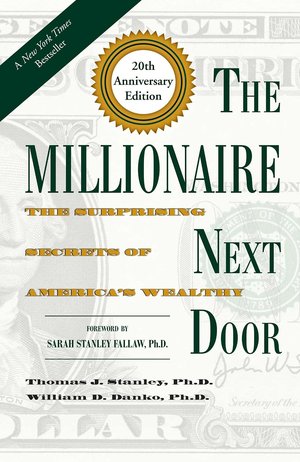
Affiliate link: as an Amazon Associate I earn from qualifying purchases. It doesn’t change the verdict.