The Little Book of Common Sense Investing makes one argument and repeats it from every angle: buy a low-cost fund that holds the whole market, keep it for decades, and stop paying people to try to beat it. John C. Bogle built Vanguard on that idea. I’m a trader, so I read it looking for the weak spot, and I checked his main claim on real data. The numbers are on his side.
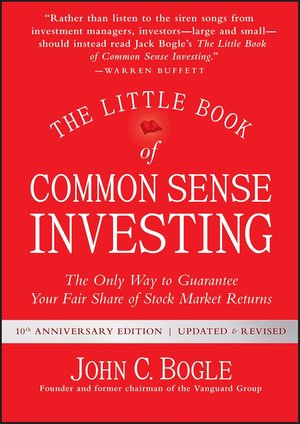
Bogle founded Vanguard, and in 1976 it launched the First Index Investment Trust, now the Vanguard 500 Index Fund. Vanguard’s own history page says industry insiders called it “un-American” at the time. He died in 2019. The book first came out in April 2007. The edition I link below is the 10th anniversary edition from 2017 (Wiley, 304 pages), with updated data and two new chapters, one on asset allocation and one on retirement investing.
The Little Book of Common Sense Investing summary
The book is short chapters with plain titles, and the titles carry most of the message: “Focus on the lowest-cost funds”, “Taxes are costs, too”, “How most investors turn a winner’s game into a loser’s game”. The reasoning is arithmetic. The market’s return is what the businesses earn, and every fee, trading cost and tax between you and the market comes out of your share of it. Trade more and you pay more, which is how, in his words, investors turn a winner’s game into a loser’s game. The cheapest way to own the market is an index fund that just holds it.
He splits the stock market’s long-run return into three parts: the dividend yield, the growth of earnings, and the change in what investors are willing to pay for those earnings. The first two come from the businesses. The third is mood. Over the long run, he argues, the business part wins over the expectations part. The rest of the book is evidence: fund performance, costs, taxes, and support from people like Warren Buffett, Benjamin Graham, Paul Samuelson and Burton Malkiel.
Does it hold up? I checked the cost argument
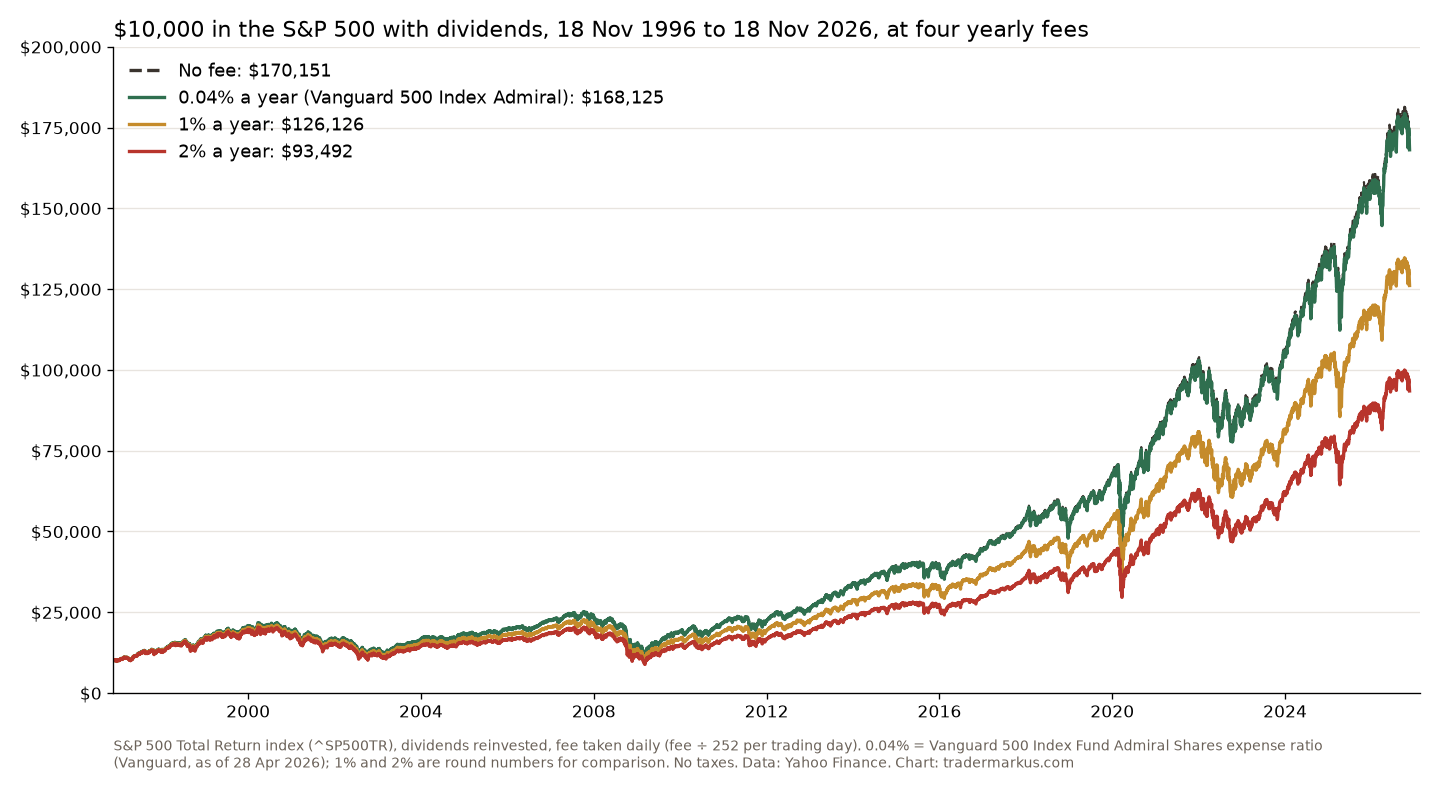
Bogle’s sharpest point is that returns compound, and so do costs. I took $10,000 in the S&P 500 with dividends reinvested, from 18 November 1996 to 18 November 2026, and ran it four times with a different yearly fee taken out each day. The 0.04% is what the Vanguard 500 Index Fund Admiral Shares charge today. The 1% and 2% are round numbers I picked for comparison, not a measured average for active funds.
| Yearly fee | $10,000 after 30 years |
|---|---|
| None | $170,151 |
| 0.04% | $168,125 |
| 1% | $126,126 |
| 2% | $93,492 |
The S&P 500 Total Return index, 18 November 1996 to 18 November 2026, with each fee taken daily. No taxes.
A 1% fee sounds small and kept 74.1% of the result. A 2% fee kept 54.9%, so the investor paid away almost half of what the market made over 30 years. Over 10 years the same 2% kept 81.9%, which is why nobody notices it at first.
Do most fund managers really lose to the index?
The other half of his case is that paying more doesn’t buy you better results. S&P Dow Jones Indices keeps score of this in its SPIVA reports. In their data to 30 June 2026, 78.69% of US large-cap funds did worse than the S&P 500 over one year, 89.32% over five years and 90.49% over fifteen years. Some managers do win. Picking them in advance is the hard part, and Bogle gives that question a chapter of its own, “Selecting long-term winners”.
He also has a chapter called “Reversion to the mean”. It’s the same phrase as my test of mean reversion trading, but Bogle works on a much longer clock than five-day trades.
What I took from it as a trader
Three things. First, costs are a sure loss and returns are not, and that goes for trading too: commissions, spreads, slippage and taxes come off every trade, winners and losers alike. A small edge disappears quickly in a high-turnover strategy.
Second, the benchmark. If I can’t beat a cheap index fund after costs over several years, the honest conclusion is to own the index fund, and Bogle makes that comparison feel personal. The S&P 500’s average return is the number any trading account should be measured against.
Third, his three sources of return are a good check on what to expect. When valuations are already high, the “mood” part has less room to add, and that matters for anyone planning around past averages.
Where I differ
The book is honest about costs and quieter about the ride. Over the same 30 years, the S&P 500 with dividends fell 55.3% from 9 October 2007 to 9 March 2009 and only got back to its old high on 2 April 2012. Bogle’s answer is to hold through it and keep part of the money in bonds, and asset allocation gets two chapters. That works for people who really do hold. Plenty of investors sell near the bottom, and then the cheap fund doesn’t save them. I think it deserves more space than costs get, because it’s where most people actually lose. The S&P 500 has had 27 bear markets since 1928, about one every five years since World War II.
And I trade, so I’m not his reader for every dollar. Trading is a separate activity with its own rules and risks, and nothing in this book says you can’t do it. It says you shouldn’t pay someone else 1% or 2% a year to do it for you and fall short of the index.
If you’ve read A Random Walk Down Wall Street, much of this will be familiar. Malkiel makes the academic case; Bogle makes the practical one, with the fees written out.
My verdict: the best short book on why low-cost index funds work, by the man who built the first one for ordinary investors. It’s repetitive, and it says less about surviving a bear market than about avoiding fees. For money you’re not going to trade, read it before you buy any fund.
Affiliate link: as an Amazon Associate I earn from qualifying purchases. It doesn’t change the verdict.