The Intelligent Investor is the book that turned Warren Buffett away from charts. I read it as someone who still uses them, and I’d still put it on every trader’s shelf. Two of its ideas, Mr. Market and the margin of safety, are as useful to a trader as to a value investor. The rest is about stock picking, and that is where Graham and I part ways.
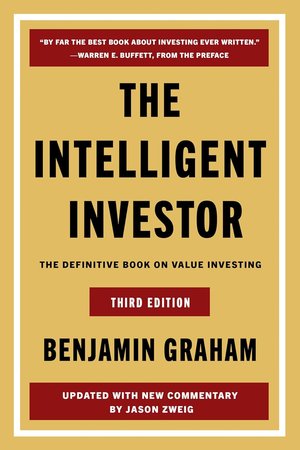
Benjamin Graham was born in London in 1894. He taught investing at Columbia Business School, ran the Graham–Newman partnership from 1936, and wrote Security Analysis with David Dodd in 1934. The Intelligent Investor came out in 1949 as the version for ordinary investors. Graham revised it several times, last in 1973, and he died in 1976. Since 2003 the book has come with chapter-by-chapter commentary by Jason Zweig, the Wall Street Journal’s personal finance columnist. The edition I link below is the third revised one from Harper Business, October 2024: Graham’s text, Zweig’s updated commentary for every chapter, and an introduction and appendix by Buffett, who studied under Graham at Columbia.
What is The Intelligent Investor about?
It is a book about behaving like an owner of a business, not a player of a ticker. The book starts from the difference between investment and speculation and splits investors into two types. The defensive investor wants safety and little work: a diversified mix of stocks and bonds, bought at reasonable prices and left alone. The enterprising investor is willing to do the research to find bargains, and Graham spends separate chapters on what each one should own.
Buffett said in his 2013 letter to Berkshire shareholders that the key points for him were in what later editions call Chapters 8 and 20. Chapter 8, The Investor and Market Fluctuations, is where Mr. Market lives. Chapter 20 calls the margin of safety the central concept of investment.
Mr. Market
Graham asks you to imagine that the market price comes from a business partner who offers every day to buy your share or sell you his. Some days he is euphoric and names a silly high price, other days he is depressed and names a silly low one. You don’t have to trade with him. Buffett retold the story in his 1987 letter and summed it up as: “Mr. Market is there to serve you, not to guide you.”
The margin of safety
Buy for clearly less than the business is worth, so that mistakes in your estimate, bad luck or a bad year don’t turn into a loss. The gap between price and value is the cushion. It is a simple idea, and almost every disaster in investing comes from ignoring it.
What I took from it as a trader
Buffett writes in the same 2013 letter that before reading the book he had tried charting and market indicators to predict stock moves, and felt he wasn’t getting anywhere. I am on the other side of that sentence – the chart is the center of how I trade. So I read Graham looking for what survives the translation, and two things do.
Mr. Market is the best description of trading psychology I know, and it is more than 75 years old. The price on my screen is an offer, not a verdict. When I feel the urge to chase a move or dump a position because the market is loud, that is Mr. Market’s mood leaking into mine. Graham’s advice works for traders too: take his price when it suits your plan, ignore it when it doesn’t.
The margin of safety is position sizing in a suit. Graham builds the cushion into the price he pays; I build it into the distance to the stop and how much I risk if it’s hit. Different tools, same respect for the fact that you will be wrong a lot. My own rule of keeping any single loss under about 1% of the account is my version of it.
Where I disagree
Graham’s method needs you to estimate what a business is worth, and Buffett, his best-known student, wrote in 1987 that success won’t come from “signals flashed by the price behavior of stocks.” I’ve spent years reading exactly those signals, and I think a trend on a chart carries information a balance sheet doesn’t. We simply play different games. The book also asks for patience measured in years, and a lot of its worked examples are companies and bond yields from Graham’s own era. Zweig’s commentary does much of the work of making it readable today, and in places the commentary is easier going than the original.
Is The Intelligent Investor still relevant?
The specific numbers have aged; the behavior hasn’t. Most bubbles since 1949 were a crowd falling under Mr. Market’s spell, and most blow-ups a missing margin of safety. The publisher updates the commentary and leaves Graham’s text alone, which is the right call. If you want the modern, story-driven version of the same temperament, read Morgan Housel’s The Psychology of Money next.
My verdict: read it, even if you never buy a stock on value. Skip around in the bond and stock-selection chapters if you must, but read Chapters 8 and 20 twice. A trader who understands Mr. Market and the margin of safety already has the two habits most traders never learn.
Affiliate link: as an Amazon Associate I earn from qualifying purchases. It doesn’t change the verdict.