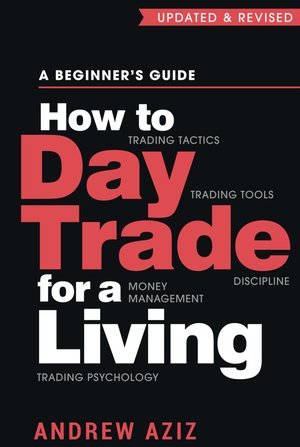
How to Day Trade for a Living by Andrew Aziz is a good first map of day trading, and it is more honest about risk than its title suggests. It explains the classic intraday setups and the position-sizing math in plain language. What it can’t give you is proof that any of it works for you. That part you have to build yourself, and the book says so.
The book is self-published and has been around in paperback since 2016. The edition I link to is the updated and revised paperback of 31 January 2021, 382 pages, with newer chart examples from the 2020 crash and the months after it. Aziz says in the description that he kept it short so you can actually finish it, and that simply reading it will not make you a profitable trader. I like an author who writes that on his own sales page.
Who is Andrew Aziz?
Andrew Aziz has a PhD in chemical engineering from the University of British Columbia and worked as a research engineer in Vancouver, at a fuel-cell research center backed by Mercedes-Benz and Ford, until he lost that job in 2014. He then turned to trading. He runs Bear Bull Traders, a day-trading community and education business, and its YouTube channel. He has since written several more books, including Advanced Techniques in Day Trading, How to Swing Trade and Mastering Trading Psychology. The book doesn’t read like a sales brochure, but keep in mind that the scanners and platform setup it shows are his own.
What is How to Day Trade for a Living about?
It starts with what day trading is and how it differs from swing trading and investing, then covers the practical side: brokers, the US pattern day trader rule, trading platforms, Level 2, hotkeys and scanners. Then come candlesticks and buying and selling pressure, the strategies, and a walk through real trades from his morning watchlist. Aziz recommends practicing on a simulator before risking real money, and he is right. Learning hotkeys with real money is an expensive way to find out which key does what.
The central idea is Stocks in Play. Retail day traders should only trade stocks that move for their own reason – fresh news, unusual pre-market volume, a gap – rather than drifting with the market. His rule is to always ask whether a stock is moving because the whole market is moving or because it has its own catalyst.
The 8 day trading strategies in the book
Chapter 7 is the core, and Aziz himself tells more experienced readers to jump straight there. It covers eight setups, each with intraday chart examples:
- ABCD pattern
- Bull flag momentum
- Top and bottom reversals
- Moving average trend
- VWAP
- Support or resistance
- Red-to-green
- Opening range breakout (ORB)
None of these are new, and they are not meant to be. They are the standard intraday setups that many retail traders watch, which is part of why they move. The VWAP and opening range chapters are the ones I find most useful even if you never day trade, because they teach you where other people’s orders sit on the chart. On a daily chart I read support, resistance and the stop the same way, only slower.
Risk management: the 2% rule and the 2:1 rule
This is the best part of the book. Aziz’s rule is never to risk more than 2% of the account on one trade, and he sizes every position in three steps: decide the maximum dollar risk, find the risk per share from entry to stop, and divide the first by the second. His minimum win:loss ratio for a trade is 2:1: the target has to be at least twice as far away as the stop. Whether 2:1 is enough depends on how often the trades actually get there, which I tested on my own backtests in my post on the risk reward ratio.
The arithmetic is simple. A $10,000 account at 2% can lose $200 on a trade. Buy at $20.00 with the stop at $19.60 and the risk is $0.40 a share, so 500 shares. At 2:1 the target is $20.80. The size comes out of the stop, not out of how sure you feel. I use 1% myself, and I’d suggest a beginner day trader use less than 2% too: someone taking several trades a day can lose 2% four times before lunch. But the method is right, and it is the same one I use on every trade.
Can you really day trade for a living?
The title asks the question the book can’t answer for you. Aziz’s own first rule is that day trading is not a way to get rich quickly, and he calls it a serious business, not gambling or a hobby. The research is harsher. In a study of Brazilian futures day traders who kept at it for at least 300 days, 97% lost money. In Taiwan, less than 1% of day traders earned predictable profits. I went through those studies and the S&P 500’s open-to-close numbers in Is day trading gambling?.
A chart example shows how a setup looks when it works. It does not tell you how often it works, or what it earns after costs. So before trading any of these setups with real size, I’d write down the rules and test them, the way I do in the Setup Lab, or at least keep a journal of a hundred simulated trades. If the numbers aren’t there, the setup is a story.
What I didn’t like
It is a beginner’s book, and an experienced trader will find little new outside chapter 7. The scanner and platform chapters date quickly. And fast, gapping stocks on news are the most demanding corner of the market: spreads widen, and one gap can take the price straight through your stop. If you prefer slower markets, Alexander Elder’s Trading for a Living covers psychology, risk and the chart with a longer time frame, and Mark Douglas’s Trading in the Zone goes deeper on the mental side.
My verdict: if you want to try day trading, read this before you open the account. It explains the setups clearly and builds the 2% sizing rule and the 2:1 rule into every trade. It will not make you profitable, as the author says himself. Treat it as the syllabus, then do the homework on a simulator and with small size, and assume you are in the losing majority until your own numbers say otherwise.
Affiliate link: as an Amazon Associate I earn from qualifying purchases. It doesn’t change the verdict.