For most people who try it, day trading works like gambling: the expected result after costs is a loss. Two large studies of real accounts say so. In Taiwan, less than 1% of day traders earned predictable profits, and in Brazil 97% of those who kept at it for 300 days lost money. The difference between a trade and a bet is a measured edge, a stop set before you click and a position size you can afford to lose.
I get this question a lot, usually from someone who has just had either a very good week or a very bad one. So here is my answer with numbers: what makes something a gamble, what the research on real day traders found, and what the S&P 500 itself looks like when you only hold it from the open to the close.
What makes something gambling?
Gambling is a bet with a negative expected value. You can win on any single spin, but the more you play, the surer the loss. Take roulette. On a European wheel 18 of the 37 pockets are red, so a bet on red wins 48.6% of the time. The house edge is 1/37, or 2.7% of every bet. On an American wheel with its extra green pocket, it is 2/38, or 5.26%. Bet $10 on red a thousand times and the average result is a loss of about $270. Some nights you walk out ahead. Over a thousand spins you almost never do.
A trade is the same kind of thing: an uncertain outcome with money on it. The question is only which side of the edge you are on. I wrote about this in the house edge: a casino wins because it has a small positive expectancy, repeats it many times and caps the size of every bet. A trader can be the casino or the player. Most day traders, it turns out, are the player.
What the studies of real day traders found
Two studies used complete records instead of surveys, which is why I trust them more than the success stories on social media.
Taiwan, 1992–2006. Brad Barber, Yi-Tsung Lee, Yu-Jane Liu, Terrance Odean and Ke Zhang analyzed every day trade on the Taiwan Stock Exchange over 15 years (“Do Day Traders Rationally Learn About Their Ability?”). More than 75% of day traders quit within two years. The group as a whole lost money, the large majority were unprofitable, and many kept trading after long runs of losses. Their earlier study on the same market found that less than 1% of the day trading population earned predictable profits.
Brazil, 2013–2015. Fernando Chague, Rodrigo De-Losso and Bruno Giovannetti followed everyone who started day trading equity futures in Brazil in those years and kept at it for at least 300 days (“Day Trading for a Living?”, 2019). 97% of them lost money. Only 0.4% earned more than a bank teller’s starting pay, about US$54 a day. They also found no evidence that people got better with practice.
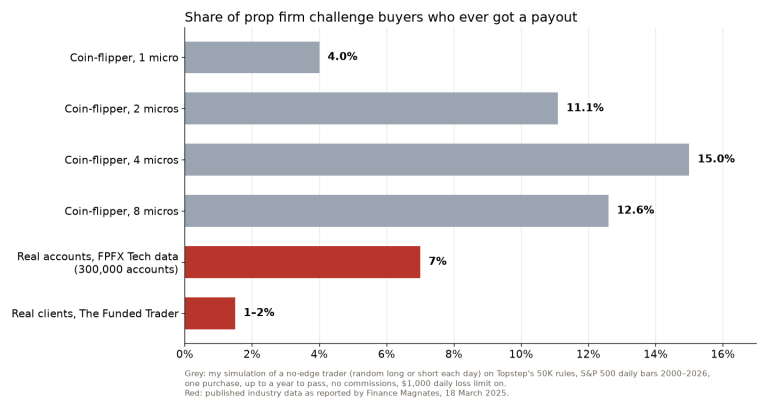
Those numbers are not a law of nature. They describe what the average person does when they start day trading: no tested method, too much size, and costs they never add up. That is exactly how a casino’s customers behave. Prop firm challenges are priced on the same habits: in my test of a $50K prop firm challenge, a trader flipping a coin got paid more often than real accounts do.
The S&P 500 from the open to the close is close to a coin flip
I wanted to see the raw material a day trader works with, so I took every trading day of the S&P 500 from 2 January 2014 to 29 September 2026 (3,204 days, Yahoo Finance data) and measured the move from the open to the close, the part of the day a day trader actually holds.
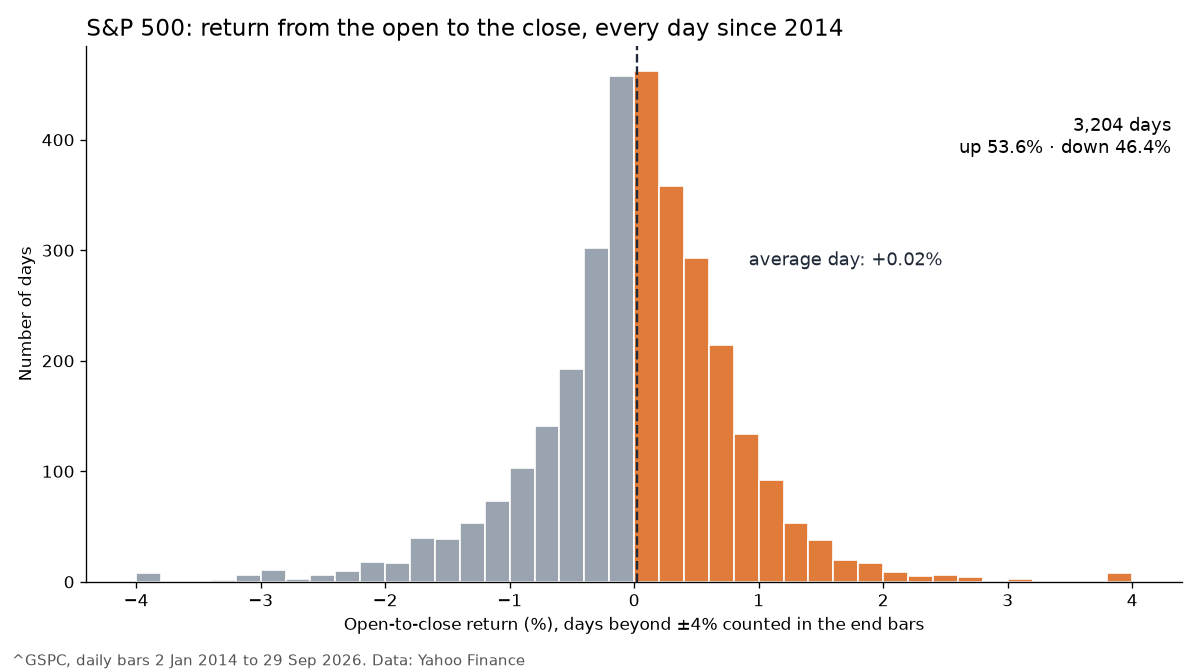
The index closed above its open on 53.6% of those days. That is a slightly better tilt than red on a roulette wheel (48.6%), but look at the size of it. The average day made +0.02%, while a typical day swung about 0.87% either way. The noise is more than 40 times the signal. On any single day the result is, for practical purposes, luck.
Now add costs. Say spread, commission and slippage take 0.05% on each round trip, which is a modest guess for a retail account. The average open-to-close day becomes −0.03%, and only 49.6% of days beat the cost. That is a roulette table. Trade five times a day on a $10,000 position at that cost and you pay $25 a day, about $6,250 over 250 trading days. That is 62.5% of the account before a single trade has gone wrong.
Meanwhile, the same index was higher a year later in 83% of all one-year windows since 2014. And here is the part that surprised me: of the index’s gain over those 12 years (×4.19 from close to close), the open-to-close part delivered only ×1.68. The overnight part, from each close to the next open, delivered ×2.47. A day trader who is flat every night was not holding the stock during most of the move.
When day trading is not gambling
A trade stops being a bet when the odds are on your side and you can prove it. For me that means four things, and none of them is a secret.
- You have measured the edge: a backtest or a journal of at least 100 real trades that shows a positive result after costs. A method you cannot put into numbers is a feeling. The rules should pick the stocks too, not a story about the company: I don’t pick stocks, the stocks pick me.
- The stop comes before the entry. The chart says where the idea is wrong, and that is where the stop goes (more in stop loss trading).
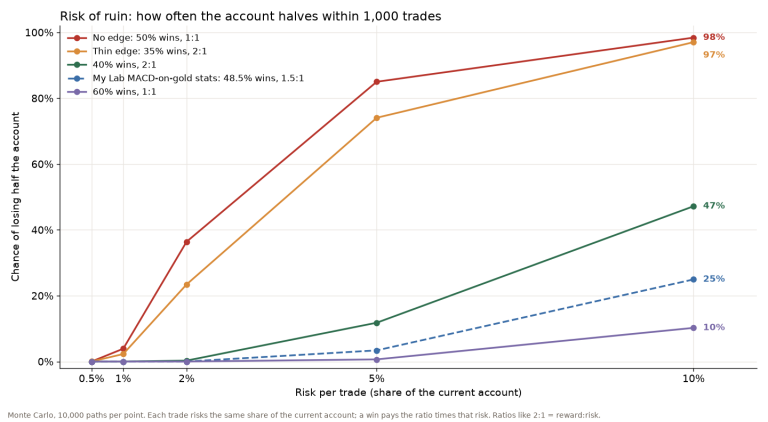
- The size comes from the stop. Risk 1% of the account per trade: on $10,000 that is $100. If the stop is $2 away, you buy 50 shares, not whatever feels right. Size, more than the method, decides whether a normal losing streak ends the account; I simulated it in risk of ruin.
- Costs are in the maths. Every backtest and every tally of your own trades includes spread, fees and slippage. The busier the method, the more this decides the result.
Even a textbook setup can fail the first test. This week I ran the hammer candle at the 50-day moving average on the S&P 500 through the Setup Lab: eight trades in almost 13 years, and it lost money while the index went up. Richard Weissman makes the same point from the other side in Trade Like a Casino: act like the house, with rules and small bets, or you are the one paying for the lights.
Signs your trading has turned into gambling
These are the ones I have seen in myself and in other traders. One of them on a bad day is human. Several of them every week means the account is a slot machine.
- You raise your size after a loss to win it back the same day.
- You move the stop or take it out because “it will come back”.
- You trade because the market is open, not because a setup is there.
- You cannot say your win rate, your average win and your average loss.
- You remember the big wins in detail and the losses only as a number that went away.
The fix is boring. Write the rules down, keep a journal and look at the numbers every month. If the numbers say you are the player, trade smaller or stop until they change. Amateurs want to be right; pros want to make money, and the money is in the tally, not in any one trade.
FAQ
Why do most day traders lose money?
Because the daily move of a liquid market is mostly noise and costs are certain. On the S&P 500 since 2014 the average open-to-close day made +0.02%, less than the 0.05% round-trip cost I assumed above. Add oversized positions and no stop, and the studies’ results (97% losing in Brazil) follow. Even the most-watched intraday line helps little: in my VWAP test, SPY above VWAP an hour after the open closed higher 56% of the time, against 52% when it was below.
Is swing trading or investing also gambling?
Holding longer changes the odds. The S&P 500 was higher after one year in 83% of the one-year windows since 2014, against 53.6% of single days from the open to the close. Longer trades pay costs less often too. Any method can still be gambling if it has no stop and no plan.
Can day trading be profitable at all?
For a small minority, yes. In the Taiwan data, less than 1% of day traders earned predictable profits. That means it is possible and very rare. If you try it, prove the edge on paper or with small size first, and assume you are in the 99% until your own numbers say otherwise.
My take: day trading is gambling when you have no edge, no stop and no idea of your numbers, and that describes most people who start. The market does not care what you call it. Keep score honestly and the score will tell you which side of the table you are on.
Not financial advice. This is educational content, shared for information and entertainment only, and it is not a recommendation to buy or sell any asset. Backtests and past results do not guarantee future results, and the numbers or charts here may contain mistakes. Trading carries risk, including losing all the money you put in. Do your own research before you make any decision.