A stop loss in trading is the price where you admit the trade idea was wrong and get out. Put it where the chart says the idea is broken – below the last swing low for a long, above the last swing high for a short – not at a round percentage. Then let the distance to that stop decide how many shares you buy, so every loss costs you the same slice of the account.
Most beginner guides stop at “always use a stop loss”. That is true and not very useful. The hard questions are where it goes, how big the position should be once it is there, and what happens when the market jumps straight through it. Here is how I answer those, with a real SPY chart and the arithmetic written out.
What a stop loss is (and what the order actually does)
A stop loss is two things that people mix up. The first is a decision: the price at which your reason for being in the trade no longer holds. The second is an order you leave with the broker so the decision gets carried out while you are asleep, at work or tempted to “give it one more day”. I care much more about the first one. An order without a reason behind it is just a random number waiting to be hit.
On the order side, the details matter. A plain stop order is a trigger, not a price guarantee. When the stop price is touched, the order becomes a market order and fills at whatever the next available price is. FINRA spells this out: in a fast market the fill can land well away from your stop price. A stop-limit order fixes the worst price you accept, but then it may not fill at all, and you are still holding the position you wanted to be out of. For a stop loss I use the plain stop. I would rather take a bad fill than no fill.
Where to put a stop loss: let the chart decide
The question I ask is simple: at what price would this chart tell me I was wrong? For a long trade in an uptrend, that is usually a little under the last swing low, the last higher low the buyers defended. If price goes back below it, the pattern of higher lows is broken and the reason for the trade is gone. For a short, it is the mirror image, a little above the last swing high. Other chart points work the same way: under a support level, under a breakout level the price should now hold, under a moving average the stock has respected for months. Day traders often put it on the other side of the session’s VWAP; what that line does and doesn’t tell you is in my VWAP test. Some traders put it under a fair value gap; if you do, put it below the zone, not inside it, because the S&P 500 trades back into those zones more often than not.
Here is a worked example on SPY, the S&P 500 ETF. On 24 September 2026 it closed at 767.18. The last clear swing low was the 16 September bar, which dipped to 749.60, closed at 754.05, and got bought straight back the next day. A long entry at 767.18 would put the stop a little under that low, at 748.50. That is 18.68 points of risk per share, about 2.4%.
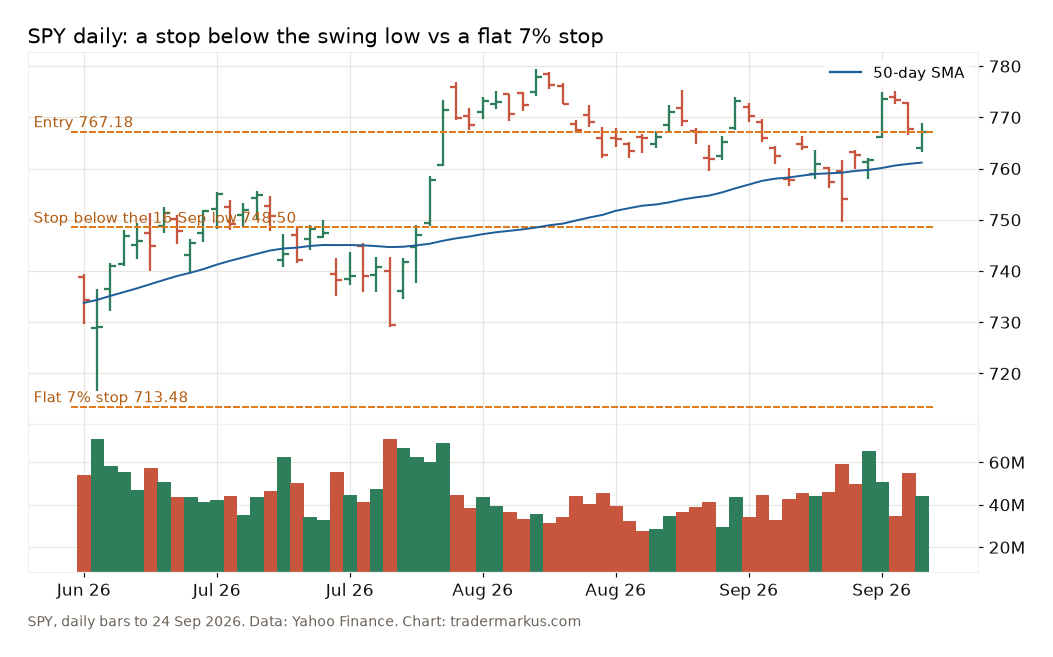
I also drew the stop you would get from a flat 7% rule: 713.48. Look at where it sits. It is below the late-June low of 716.58, below everything on this three-month chart. The market would have to undo its whole summer before that stop said anything. The 7% came from a rule book, and this chart never had a say in it.
Why not a tight stop just under the entry?
The opposite mistake is the stop that is too close. SPY’s average daily range over the last 14 sessions (the ATR) was 6.73 points as of 24 September. A stop two ATRs below the entry lands at 753.72. That sounds careful, but the 16 September bar went down to 749.60 – one ordinary bad day would have taken you out, right before the move back to 773. A stop that sits inside the normal noise will be hit by the noise. Put it where the noise stops and the structure starts.
Stop loss and position size: the part most traders skip
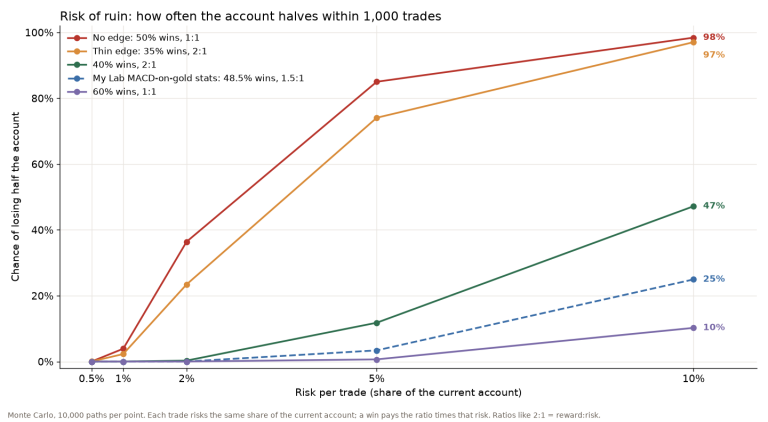
Now the stop starts earning its keep. The stop tells you how much you lose per share. Your risk per trade tells you how much you are willing to lose in total. Divide one by the other and you have the position size. I wrote about always using the same risk size years ago and still think it is the single most useful habit in trading. How big that risk should be is a separate question: in my risk of ruin simulation, even a solid edge lost half the account in 47% of the runs at 10% per trade, and practically never at 1–2%.
Say the account is $25,000 and the risk per trade is 1%, so $250:
| Stop | Swing low | Flat 7% |
|---|---|---|
| Stop price | 748.50 | 713.48 |
| Risk per share | 18.68 | 53.70 |
| Shares | 13 | 4 |
| Loss if hit | $243 | $215 |
Shares = $250 ÷ risk per share, rounded down. The position size sheet in my free trading journal template does this sum for you. Both lose about the same money if they are wrong. The difference is that the chart-based stop lets you hold three times as many shares for the same risk (a $9,973 position against $3,069), and it tells you much sooner that you were wrong. The 7% stop is not “safer”. It just buys you a smaller position and a longer wait. What is dangerous is doing it the other way round: buying a fixed number of shares because it feels right and then placing the stop wherever the loss “doesn’t hurt too much”. That is how a sensible stop turns into a hope.
If you want a whole book on the sizing side, Tom Basso’s Successful Traders Size Their Positions covers it well.
Can you lose more than your stop loss?
Yes. A stop is a trigger, so a gap goes straight through it. If a stock closes at $50 with your stop at $47 and opens at $41 after an earnings miss, the stop turns into a market order at the open and you get something near $41, not $47. The same thing happens in thin pre-market or post-market trading and in fast markets, which is the point FINRA makes. This is why I size positions for the stop and still keep single-stock positions small going into earnings. SPY gaps less than a single stock because it holds the whole index, but it gaps too.
Two more ways to lose more than planned, both self-made: moving the stop lower “just this once”, and canceling it before a news event and forgetting to put it back. If the stop moves, it moves only in the direction of the trade. Once the stop and the target are in, the best thing to do is usually nothing, which is the point of my older post Everything between the entry and exit is unimportant.
Trailing stops: moving the stop as the trade works
Once a trade moves in your favor, the question changes from “where was I wrong” to “how much of the gain am I willing to give back”. I trail the stop the same way I set it: under each new swing low as the trend makes higher lows. Some traders use a fixed percentage or an ATR multiple instead, and many brokers offer a trailing stop order that does it automatically. Whatever you use, it only ever moves up for a long. I wrote about why I think of this as exiting rather than taking profits or losses; the stop is simply where the exit is.
FAQ
What is the 7% rule for stop losses?
It comes from William O’Neil’s How to Make Money in Stocks: cut any loss when a stock falls 7–8% below your buy price, no exceptions. It fits his style of buying growth stocks as they break out. On a trade where the chart’s own stop is 2% away, 7% is too wide.
What is the golden rule for a stop loss?
Set it before you enter and never move it against the trade. The old trading version is “cut losses quickly, let profits run“. A 50% loss needs a 100% gain to get back to even, so small losses are the whole game.
Is a 20% stop loss good?
For a short-term trade, almost never: it usually sits far below any level the chart cares about, and it forces a tiny position. For a long-term holding in a volatile stock it can be where the chart says the trend is over. The percentage is a result of the chart, not an input.
Should I use a stop-market or a stop-limit order?
For a stop loss, a stop-market order, because the job is to get you out. A stop-limit can leave you holding the stock after a gap, which is exactly what the stop was supposed to prevent.
What is a buy stop loss?
It is the stop loss for a short position. A buy stop sits above the current price, and when the price rises to it, it turns into an order to buy, which closes the short. FINRA describes it the same way: a buy stop “can help you try to limit losses on a short position”. Where to put it is the mirror image of a long trade, a little above the last swing high. The same order type is also used to buy a breakout, but then it is an entry, not a stop loss.
A stop loss is the price where I stop arguing with the market. Put it where the chart says the idea is dead, size the trade so that price costs you the same as every other loss, and then let it do its job. If you want to practice reading those levels, the weekly levels mark the S&P 500’s support and resistance every Monday.
Not financial advice. This is educational content, shared for information and entertainment only, and it is not a recommendation to buy or sell any asset. Backtests and past results do not guarantee future results, and the numbers or charts here may contain mistakes. Trading carries risk, including losing all the money you put in. Do your own research before you make any decision.