Most day traders make nothing. They lose money. In one large study of real accounts, 97% of Brazilians who day traded futures for at least 300 days lost money, and only 0.4% earned more than a bank teller’s starting pay, about $54 a day. For the few who do make money, income is simple maths: account size times return. To earn the US median full-time pay of $64,064 a year at a good 20% return, you need about $320,000 in the account.
The question “how much do day traders make” usually comes with a picture attached: a laptop, a beach, $1,000 a day. So here are the numbers instead, from real account records, the brokers’ own disclosures, and the arithmetic every trader should do once before quitting anything.
Why “day trader salary” sites show a number
Search for a day trader salary and you get a neat yearly figure from the job sites. Those numbers come from job ads and pay reports of people who trade for a firm: a bank, a fund, a prop shop. They get a salary because they trade the firm’s money under the firm’s rules. A retail day trader has no salary. Their income is their profit after costs, it arrives in lumps, and in most years for most people it is negative. Don’t plan your life around a number that describes someone else’s job.
What real day traders earned: the studies
Two research groups had something better than surveys: every trade, from the regulator or the exchange.
Brazil, 2013–2015. Fernando Chague, Rodrigo De-Losso and Bruno Giovannetti followed all 19,646 people who started day trading mini-Ibovespa futures in those years (“Day Trading for a Living?”, 2019). Of those who kept at it for 300 days or more, 97% lost money and 0.4% earned more than a bank teller’s starting pay of US$54 a day. The best one in the whole group averaged US$310 a day, with a standard deviation of US$2,560. That trader’s typical daily swing was eight times the average day’s pay. They found no sign that people got better with practice.
Taiwan, 1992–2006. Brad Barber, Yi-Tsung Lee, Yu-Jane Liu and Terrance Odean looked at every day trader on the Taiwan Stock Exchange over 15 years. Fewer than 1% of them could predictably and reliably earn positive returns after fees. A small group of winners exists, and it stays small.
You can check the same thing yourself on any UK broker’s website, where the regulator makes them print it. On 30 October 2026 IG said 70% of its retail accounts lose money on spread bets and CFDs, CMC Markets said 69%, and Plus500 said 76%. CFD accounts are not all day traders, but they are mostly short-term leveraged traders, and more than two out of three of them are paying, not getting paid. I wrote more about the studies, and why this looks so much like a casino, in is day trading gambling.
The maths: income = account size × return
Say you are one of the few with a real edge. What you can take home is your account size times your return after costs. The US median full-time worker earned $1,232 a week in the third quarter of 2026 (BLS), which is $64,064 a year. Here is the account you need to match it:
| Return a year after costs |
Account needed for $64,064 |
|---|---|
| 10% | $640,640 |
| 20% | $320,320 |
| 30% | $213,547 |
| 50% | $128,128 |
| 100% | $64,064 |
For scale, the S&P 500 has returned about 10% a year with dividends since 1928 (S&P 500 average return), and you get that by doing nothing. Every row below 10% would be a reason to stop day trading and buy the index. The rows above it are where the course sellers live. A trader who makes $200 a day on a $25,000 account is making 200% a year without compounding. Hardly anyone does that for long, and the ones in the studies above certainly didn’t.
An average return is not a monthly salary
Even the table flatters it, because it assumes the same return every year. Suppose you were good enough to earn exactly what the S&P 500 earned each year from 2001 to 2025, on $640,640, the stake that pays the median wage at 10%. This is what your “salary” would have looked like:
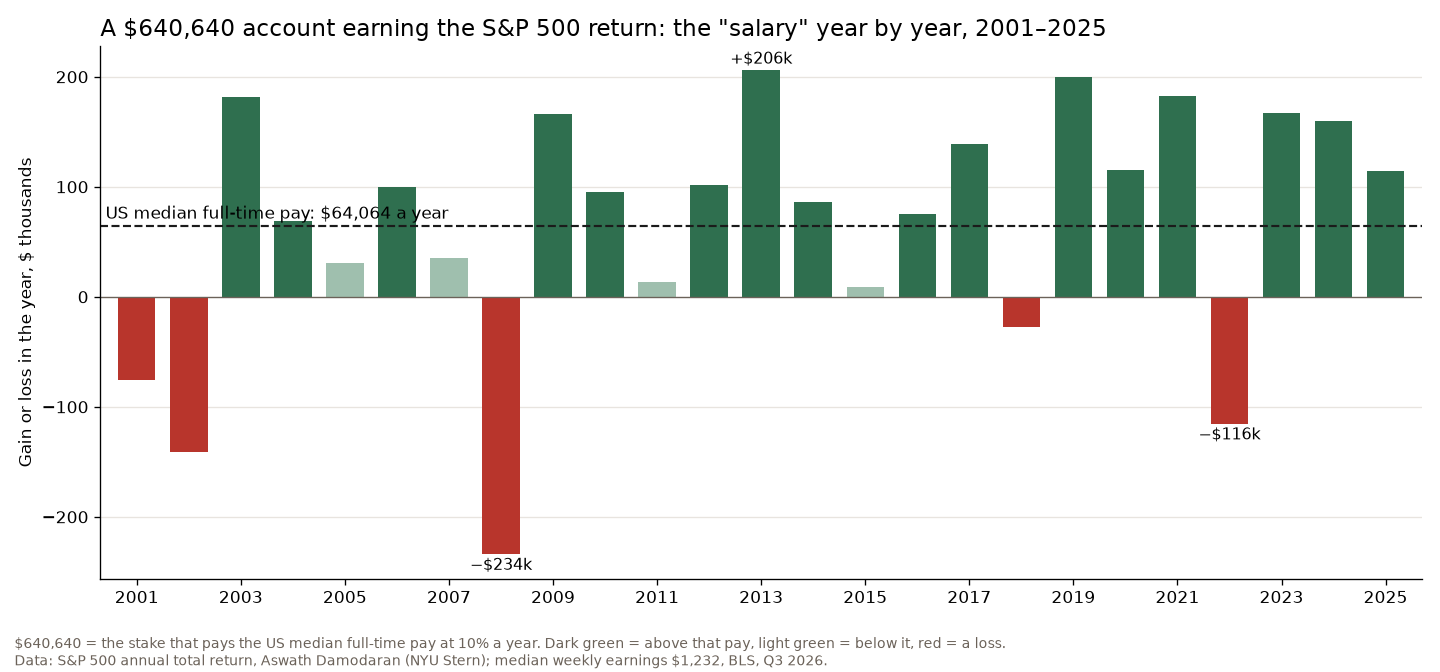
The average year paid $66,109, a bit above the median wage. But only 16 of the 25 years reached it, 5 were losses, and the spread between them is the whole story: −$234,154 in 2008, +$205,966 in 2013, −$115,571 in 2022. A day trader’s year is usually more volatile than the index, not less. Bills arrive every month whatever the market did. This is why Kevin Davey kept savings for three to five years of living costs when he went full time, which felt more than enough to me when I reviewed his book.
Do you still need $25,000 to day trade?
In the US, not by rule any more. FINRA replaced the pattern day trader rule, including its $25,000 minimum, with intraday margin standards that took effect on 4 June 2026 (Regulatory Notice 26-10). Brokers can phase the change in until 20 October 2027, so yours may still apply the old rule. A smaller entry ticket doesn’t change the table, though. With $5,000 in the account, even a 50% year pays $2,500. That’s a hobby with risk, not an income.
What I would tell someone who wants to day trade for a living
I have day traded. Back in 2019 I did it on hourly and 10-minute charts to get more trades and practice faster, and the same year I decided to put less effort on day trading and follow the bigger moves. Later I ran a rule-based day-trade system, and in the house edge I wrote that it had the smallest edge of my strategies, though the highest annual return in the backtests, and that I still didn’t give it much capital. Short holding periods mean many trades, and many trades only pay if the edge is real and survives the costs. An investment banker once told me, “We don’t believe in day-trading”. Most of the numbers above agree.
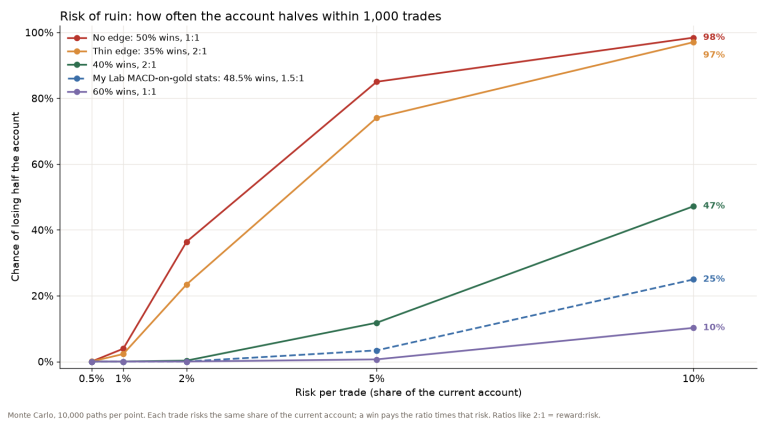
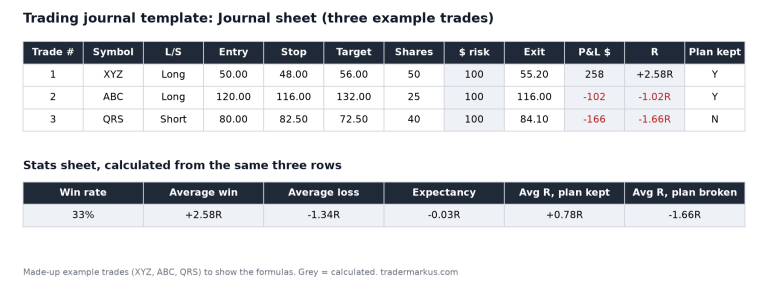
So my order of things is boring. Keep your income. Log at least 100 trades in a trading journal and look at the result after costs. Size every trade from the stop, about 1% of the account at risk, so a bad month doesn’t end it (I simulated that in risk of ruin). Then put the journal’s return into the table above. If the row it lands on doesn’t pay your bills, you have your answer without losing the savings to find it.
FAQ
How much do day traders make a day?
Most make a loss. In the Brazil study only 0.4% of persistent day traders beat US$54 a day, and the best of 19,646 averaged US$310 a day with huge swings. A profitable trader’s daily income is account size times daily return, and many single days are losses.
Can you make $500 a day day trading?
$500 a day over 250 trading days is $125,000 a year. At a strong 20% a year after costs that takes a $625,000 account; at 50% it takes $250,000. On a $10,000 account it would mean 1,250% a year, which no study of real traders shows anyone doing for long.
Do most day traders lose money?
Yes. 97% of Brazilian day traders who lasted 300 days lost money, fewer than 1% of Taiwanese day traders were reliably profitable after fees, and UK CFD brokers report that 69–76% of their retail accounts lose money.
How much money do you need to start day trading?
Since June 2026 the US has no $25,000 minimum by rule, though some brokers keep it until October 2027. To live from it you need far more: about $320,000 to earn the US median wage at 20% a year.
Day trading can be a job, but it pays like a business that may or may not turn a profit this year. Run the numbers on paper first. It’s the cheapest lesson in trading.
Not financial advice. This is educational content, shared for information and entertainment only, and it is not a recommendation to buy or sell any asset. Backtests and past results do not guarantee future results, and the numbers or charts here may contain mistakes. Trading carries risk, including losing all the money you put in. Do your own research before you make any decision.