The pattern day trader rule is gone. FINRA replaced it with new intraday margin rules that took effect on 4 June 2026: day trades are no longer counted, and the $25,000 minimum no longer exists. A margin account now needs $2,000 of equity, the same as any other margin account. Brokers can phase the change in until 20 October 2027, so yours may still run the old rule. What the change doesn’t remove is the risk, so I checked how big a position a $2,000 account actually needs on SPY. With 1% risk and a stop one average day away, the median since 1993 is 85% of the account.
What was the pattern day trader rule?
Under the old rule, four or more day trades within five business days in a margin account made you a “pattern day trader”. From then on the account needed at least $25,000 of equity. Below that, the broker restricted it. A day trade meant buying and selling the same security on the same day.
For a small account the practical effect was a cap: three day trades in any five business days, then wait. It applied only to margin accounts. Cash accounts never had a day trade count, but they have their own rules, which haven’t changed (more on that below).
What changed in June 2026
The SEC approved FINRA’s amendments to Rule 4210, the margin rule, on 14 April 2026. FINRA’s Regulatory Notice 26-10 says the new intraday margin standards replace the old day trading margin requirements “in their entirety”, including the day trade count and the $25,000 minimum.
| Before | Since June 2026 | |
|---|---|---|
| Day trades |
4 in 5 business days = pattern day trader | Not counted |
| Minimum equity |
$25,000 for a pattern day trader | $2,000, as for any margin account |
| Intraday buying power |
From the previous day’s close | From positions during the day |
Sources: FINRA Regulatory Notice 26-10, FINRA Rule 4210 and FINRA’s investor page on frequent intraday trading; the last row as E*TRADE describes it.
The $2,000 isn’t new. FINRA’s margin rule already required equity of at least $2,000 in a margin account, and your broker can ask for more. FINRA calls those “house” requirements.
What replaces the count is a margin check during the day. If your positions need more margin than the account has, you have an “intraday margin deficit”. The broker must require you to cover it as promptly as possible, by depositing money or closing positions. If you make a practice of not covering deficits and one is still open after five business days, the broker has to stop you from borrowing more or adding to short positions for 90 days, or until you cover it. Small deficits, up to 5% of the account’s equity or $1,000, whichever is lower, don’t count towards that practice.
Does my broker still use the old rule?
Maybe. The rule took effect on 4 June 2026, but FINRA gave brokers 18 months to implement it, until 20 October 2027. Schwab said it would stop counting day trades on 8 June. E*TRADE says it made the change on 9 June. I haven’t read every broker’s page, so I won’t guess about the others. If your broker still shows a day trade counter, it is still on the old rule, and its own help page should say when that ends.
What didn’t change: cash accounts
In a cash account you still pay for everything in full. Stocks settle one business day after the trade (T+1). Selling a stock you bought with money that hasn’t settled yet is a “good faith violation”. Buying and selling without paying at all is free-riding under the Federal Reserve’s Regulation T, and it can get the account restricted for 90 days. None of that was part of the pattern day trader rule, so none of it went away with it.
A margin account also still means you can lose more than you put in. That part of the rule book didn’t get friendlier.
How big a position does a $2,000 account need?
The new rule mostly matters to people with less than $25,000, so I looked at what a small account actually needs. My own rule is the one I use on every trade: the chart sets the stop, and the size follows from the distance to it (I wrote it up in how I use stop losses). With 1% risk, a $2,000 account can lose $20 on a trade.
For the stop I used SPY’s average true range over 14 days, a common measure of how far the price moves on a normal day. On 23 November 2026, after a 3.7% fall in the S&P 500 on the Friday and a 4.7% rise on the Monday, its biggest one-day gain since April 2025, SPY closed at $722.29 and its average day was $15.35. A stop $15.35 away with $20 at risk allows 1.3 shares, about $940 worth, or 47% of the account. On 5 November the average day was $10.60, and the same $20 of risk allowed 69% of the account. The wilder the market, the smaller the position.
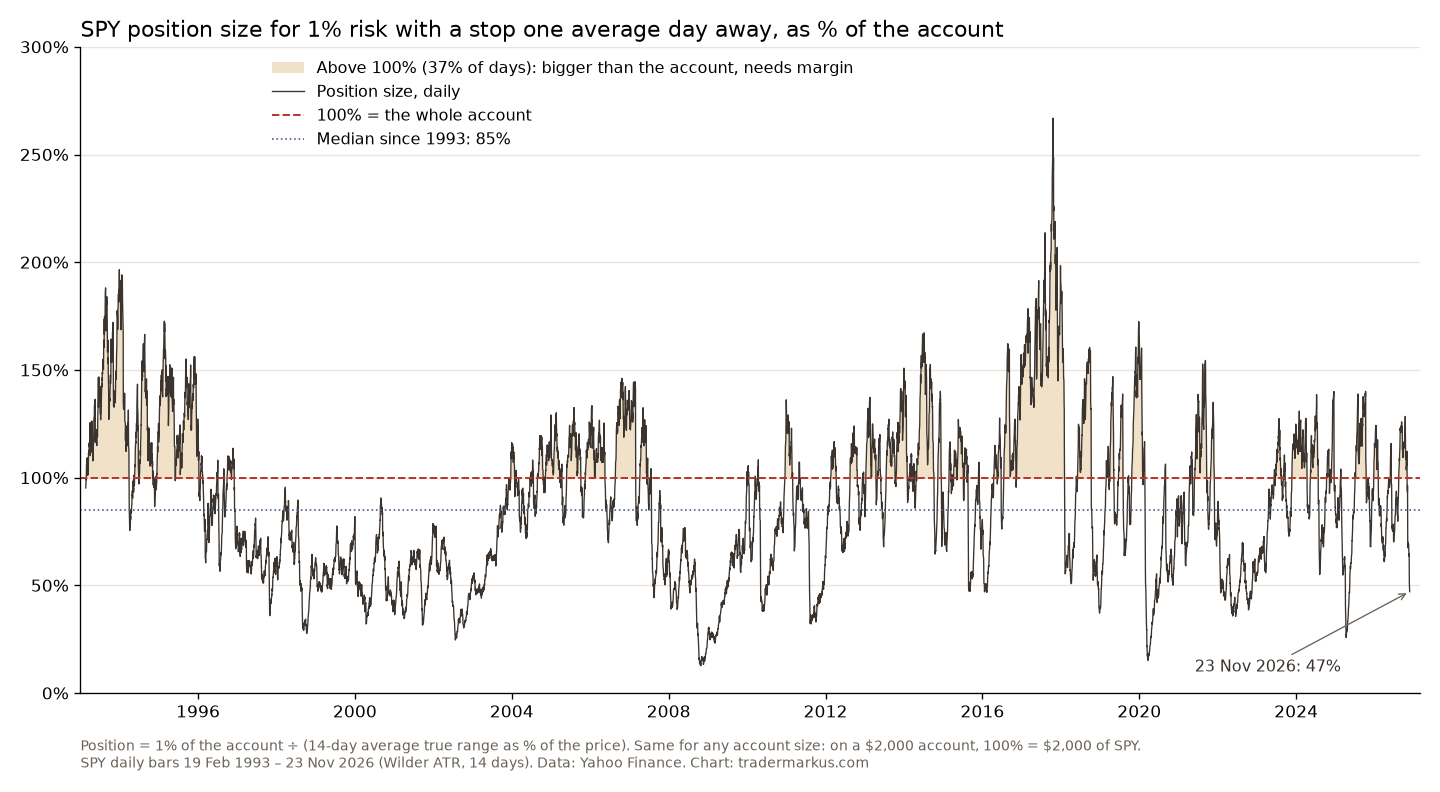
I ran the same calculation for every trading day since February 1993, 8,499 days. The median position was 85% of the account. On 37% of the days it would have been more than 100%, which means it needed margin. Those were the calm years. In 2017 the median was 166% of the account, because SPY barely moved. In 2008 it was 48%, and at the worst point of 2008 just 13%.
So a $2,000 account trading SPY with a stop one normal day away needs little or no leverage most of the time. It needs a lot of it only when the stop is a small fraction of a normal day’s range. That is a very different trade, where the spread and the noise take a bigger share of every result.
The rule is gone, the risk isn’t
The old rule was a blunt brake: three day trades in five business days, then wait. Now nothing in the rules limits how often a $2,000 account trades. The limit has to come from the trader. When I simulated a trader with no edge risking 2% per trade, the account halved in 36% of the runs. That’s in my risk of ruin post, where the size of each bet mattered far more than the strategy.
The money side doesn’t change either. A smaller entry ticket means smaller profits as well as smaller losses. I worked through that in how much day traders make: even a 50% year on $5,000 pays $2,500.
Not financial advice. This is educational content, shared for information and entertainment only, and it is not a recommendation to buy or sell any asset. Backtests and past results do not guarantee future results, and the numbers or charts here may contain mistakes. Trading carries risk, including losing all the money you put in. Do your own research before you make any decision.
FAQ
Is the PDT rule already gone?
Yes, in FINRA’s rule book since 4 June 2026. Brokers have until 20 October 2027 to switch, so check whether yours still counts day trades.
Is the PDT rule changing to $2,000?
Not exactly. The pattern day trader rule and its $25,000 minimum were removed. The $2,000 is the minimum equity for any margin account, and it was there before. Your broker can require more.
Can I day trade with less than $25,000 now?
In a margin account, yes, if your broker has made the change and you keep at least $2,000 of equity and cover any intraday margin deficit. In a cash account you always could, with settled money only.
Does the PDT rule apply to cash accounts?
It never did. Cash accounts have their own limits: you pay in full, trades settle the next business day, and selling before the money has settled can be a good faith violation.