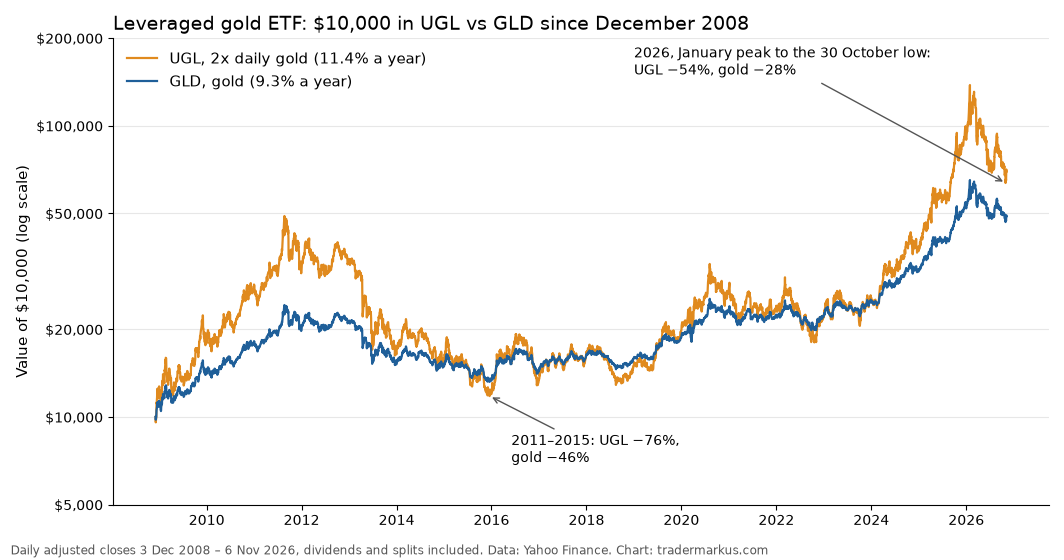
A leveraged gold ETF like ProShares Ultra Gold (UGL) aims for twice gold’s daily move, not twice its long-term return. Since it launched in December 2008, UGL has made 11.4% a year against 9.3% for gold through GLD: twice the swings for about two extra points a year. It fell 76% in the 2011–2015 gold bear market, and from gold’s January 2026 peak to its 30 October low UGL fell 54%, against 28% for gold.
What is a leveraged gold ETF?
It’s a fund that uses futures or swaps to give you a multiple of gold’s move in a single day. UGL is the best-known one in the US. According to ProShares, it seeks two times the daily performance of the Bloomberg Gold Subindex, a gold futures index, before fees and expenses. It started trading on 1 December 2008 and its expense ratio is 0.95% a year. There are also leveraged funds on gold miners, such as Direxion’s NUGT, but those follow mining stocks, which is a different and much more volatile thing than gold itself.
The word that matters is daily. The fund resets its leverage every day, so over a day it does roughly what it promises. Over a month or a year it can be well above or well below two times gold’s return, depending on the path gold took to get there.
UGL vs GLD: what 2x gold really returned
I took Yahoo Finance’s adjusted daily closes for UGL and for GLD, the big gold ETF that holds bullion, from UGL’s first close on 3 December 2008 to 6 November 2026. Before using them, I checked UGL’s numbers against ProShares’ own quarter-end returns to 30 September 2026: one, five and ten years matched to the hundredth of a percent.
| Dec 2008 – Nov 2026 | UGL | GLD |
|---|---|---|
| Per year | 11.43% | 9.26% |
| $10,000 became | $69,621 | $48,900 |
| Volatility | 34.7% | 17.2% |
| Worst drawdown | −75.9% | −45.6% |
Twice the volatility, as promised. The return is where it falls short. Doubling gold’s 9.26% a year would be 18.5%. Even a perfect fund that held 2x GLD and rebalanced every day, with no costs at all, would have made 15.9% a year. UGL made 11.4%.
Why a 2x gold ETF doesn’t double gold’s return
Three things eat the difference. The first is the daily reset. Say gold rises 10% one day and falls 10% the next: it ends 1% down. A 2x fund rises 20% and then falls 20%, and ends 4% down. The more gold zigzags, the more a daily-leveraged fund loses compared with a plain 2x bet, and gold’s volatility was about 17% a year over this period.
The second is the cost of the leverage itself. The second unit of gold is effectively borrowed, and borrowing costs roughly the short-term interest rate. The third is the 0.95% fee. When I added both to my daily 2x GLD model, using the 3-month T-bill rate, it came down to 13.2% a year. The remaining 1.7 points a year or so is UGL’s own: it tracks gold futures, not the bars GLD holds, and it has trading costs my model doesn’t. I can’t split that last part exactly, but the result is clear enough.
It also shows up year by year. In 15 of the 17 full calendar years from 2009 to 2025, UGL made less than twice what GLD made. In 2020 gold rose 24.8% and UGL 39.0%, not 49.6%. The exceptions were 2013, a big down year, and 2025, when gold rose 63.7% in a steady climb and UGL made 137.6%. Leverage pays when a trend runs smoothly in one direction. Most years aren’t like that.
Is a leveraged gold ETF a good long-term investment?
Look at the two bear markets. From the August 2011 peak to the December 2015 low, GLD fell 45.6% and UGL 75.9%. GLD got back to its 2011 high in July 2020, 8.9 years later. UGL needed until March 2025, 13.6 years. When gold was finally back where it started, UGL was still 37% below its own 2011 peak.
2026 is a fresh example. GLD peaked on 29 January 2026 and fell 28.3% to its low on 30 October. UGL fell 53.9% over the same days. By 6 November gold was still 24.9% below the peak and UGL 49.5%. Anyone who bought UGL on that January day needs it to almost double just to get back.
So for buy and hold, my answer is no. You get the full downside of a bear market twice over, a longer recovery, and an upside that the costs and the zigzag shave down. In rolling one-year windows, UGL beat twice GLD’s return only 9.8% of the time. If you want more gold exposure for the long run, holding more gold does the job more cheaply. A deep drawdown also costs more than it looks, as I showed in compounding is the eighth wonder of the world: a 50% fall needs a 100% gain to recover.
How I’d use a 2x gold ETF
As a trading tool for days or weeks, sized for the leverage. If a setup on gold would normally get a $10,000 position, the same risk in UGL is about $5,000, and the stop has to be set on UGL’s own chart, roughly twice as far in percentage terms. I would only hold it while gold is trending. My weekly levels include gold, and my test of MACD crossovers on gold is a good reminder that a simple gold signal loses often: 136 of its 264 trades lost money. A trade that goes wrong in a leveraged fund goes wrong twice as fast, so the stop loss matters even more than usual.
FAQ
Is there a 2x gold ETF?
Yes. ProShares Ultra Gold (UGL) targets twice the daily return of the Bloomberg Gold Subindex, and ProShares says it is the only ETF that targets 2x the daily returns of gold futures. There are also 2x funds on gold mining stocks, which follow miners, not gold.
Can you hold UGL long term?
You can, but over 2008–2026 it made only about two points a year more than gold, with twice the volatility, a 76% drawdown and a 13.6-year wait to recover its 2011 high. Its own objective is a daily one.
Why did UGL fall twice as much as gold in 2026?
Because that is the design. From GLD’s peak on 29 January to its low on 30 October 2026, gold fell 28.3% and UGL 53.9%. A daily 2x fund in a falling market loses about twice as much, and a bit more when the fall is choppy.
Leverage on gold doesn’t change what gold does. It changes how much of it you can sit through. Most people who buy 2x gold for the long run find out in the first bear market.
Not financial advice. This is educational content, shared for information and entertainment only, and it is not a recommendation to buy or sell any asset. Backtests and past results do not guarantee future results, and the numbers or charts here may contain mistakes. Trading carries risk, including losing all the money you put in. Do your own research before you make any decision.