Netflix has split its stock three times: 2-for-1 in February 2004, 7-for-1 in July 2015 and 10-for-1 in November 2025. One share from its first year of trading is 140 shares today. The splits didn’t make anyone richer by themselves: a year after the 2004 split NFLX was down 68.5%, and from the 2025 split to 6 November 2026 it fell 43.0% while the S&P 500 gained 10.8%. On 28 October 2026 it closed at $61.99, its lowest close since August 2024.
Netflix stock split history
These are the three splits, with the last closing price before each one in the dollars people actually paid at the time, and what the stock did over the next twelve months. The split dates are the first day of split-adjusted trading, from Yahoo Finance’s split records; the 2025 dates are also in Netflix’s own announcement.
| Split | Price before | Next 12 months |
|---|---|---|
| 2-for-1, 12 Feb 2004 | $71.96 | −68.5% S&P +5.2% |
| 7-for-1, 15 Jul 2015 | $702.60 | −3.9% S&P +4.3% |
| 10-for-1, 17 Nov 2025 | $1,112.17 | −43.0% so far S&P +10.8% |
2 × 7 × 10 makes 140, so anyone who bought one share before 2004 and held on now owns 140. The S&P 500 figures are the total return index, dividends included, over the same days. Twelve months after the 2025 split will be 14 November 2026, so that row is the result to 6 November 2026.
How much was Netflix stock when it split?
The last close before the 2004 split was $71.96, on 11 February 2004; the first split-adjusted close was $37.30. Before the 2015 split it closed at $702.60 on 14 July 2015 and at $98.13 on the first day after. Before the 2025 split it closed at $1,112.17 on 14 November 2025, and the first split-adjusted session ended at $110.29. Charts today show all of these divided by the later splits, which is why Netflix’s 2004 price shows up as about 51 cents on Yahoo.
What a stock split changes, and what it doesn’t
A 10-for-1 split gives you ten shares at a tenth of the price. Your position is worth exactly the same before and after; the company is worth the same; nothing about the business changes. Netflix said its reason for the 2025 split was to “reset the market price of the Company’s common stock to a range that will be more accessible to employees”. A lower price can make a stock easier to buy in whole shares, and announcements sometimes get a small bounce, but that is all a split can do.
Netflix’s own history shows it. After the 2015 split the stock rose 20.1% in the first month while the S&P 500 slipped, and was still ahead six months later, then gave it back and finished the year down 3.9%. After the 2004 split it fell 57.3% within six months. Three splits are far too few to say anything about splits in general. What they show is that the stock went on doing whatever the business and the market were doing.
Netflix stock since the 2025 split
Netflix announced the 10-for-1 split on 30 October 2025, when the stock closed at $1,089.00, and it rose 2.7% the next day. On 18 November 2025, the second day of split-adjusted trading, it closed at $114.09, which is still the highest close since the split. Measured from the last pre-split close, it was down 15.0% after a month and 29.9% after three months. In 2026 it is down 32.4% so far, while the S&P 500 total return is up 8.8%. The all-time high close was $133.91 on 30 June 2025, $1,339.13 before the split, so on 6 November the stock was 52.6% below it.
The latest leg down came after the third-quarter results on 20 October 2026. In its shareholder letter Netflix reported revenue up 12% on the year, in line with its own forecast, and diluted earnings of $0.87 a share against $0.59 a year earlier. The problem was the outlook. It now expects 2026 revenue of $51.1 billion, 0.2% below the middle of its previous range, and ad revenue of about $2.7 billion against about $3 billion before. The stock fell 5.3% the next day to $65.04, and a week later it was at $61.99.
Is Netflix a good stock to buy after the split?
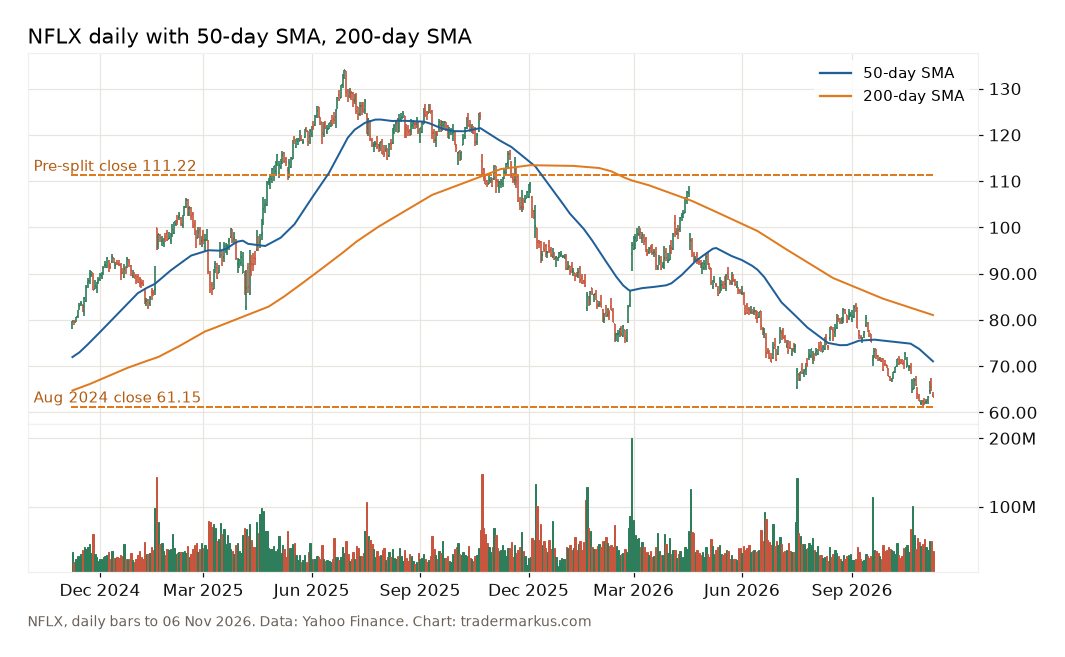
The chart says the trend is down. On 6 November 2026 NFLX closed at $63.41, below a falling 50-day average at $71.03 and a falling 200-day average at $81.04, 22% under it. Every rally since November 2025 has stopped below the previous high: the February–April bounce topped out under the pre-split price, the late-summer one under $85. The low since the split is the 28 October close at $61.99, just above the August 2024 close at $61.15, the last time it closed that low. Below that, the 2024 low close was $46.85, on the first trading day of that year.
I don’t buy a stock because it is cheaper than it was a year ago. That is the same reasoning that made people buy the 2004 split on the way to −68%. For me a falling stock becomes interesting when it stops falling: a close back above the 50-day average, then a higher low that holds. Until then it is a downtrend with a story attached, and I would rather pay more later for a trend I can see. If you do buy here, the stop has to go somewhere the chart proves you wrong, and a close under $61 is the obvious place, as I explain in where to put a stop loss. It is the same approach I used in my NVDA support and resistance read.
For perspective, Netflix has been a great stock over most of its life. In 64.8% of all one-year windows since 2002 it beat the S&P 500, by a median of 37.2 percentage points. But averages like that come from the years when it was trending up, not from the years like this one, and the split has nothing to do with either. Buying weakness without a plan is a different thing from buying the dip in an index, where the long-term trend has always come back.
FAQ
When did Netflix stock split?
Three times: a 2-for-1 split effective 12 February 2004, a 7-for-1 split effective 15 July 2015, and a 10-for-1 split with split-adjusted trading from 17 November 2025. Netflix announced the last one on 30 October 2025.
What was Netflix’s stock price before the split?
$1,112.17 at the close on 14 November 2025, the last day before the 10-for-1 split. That is $111.22 in today’s split-adjusted terms. Before the 2015 split it was $702.60, and before the 2004 split $71.96.
Did the stock split make Netflix go up?
No. It rose 2.7% the day after the announcement and was 2.1% higher by the last pre-split close, but by 6 November 2026 it was 43.0% below that close. A split changes the number of shares, not the value of the company.
Three splits, three different outcomes, and the reason was the business and the market every time. If you hear that a split is coming, the useful question is the same as on any other day: what is the chart doing?
Not financial advice. This is educational content, shared for information and entertainment only, and it is not a recommendation to buy or sell any asset. Backtests and past results do not guarantee future results, and the numbers or charts here may contain mistakes. Trading carries risk, including losing all the money you put in. Do your own research before you make any decision.