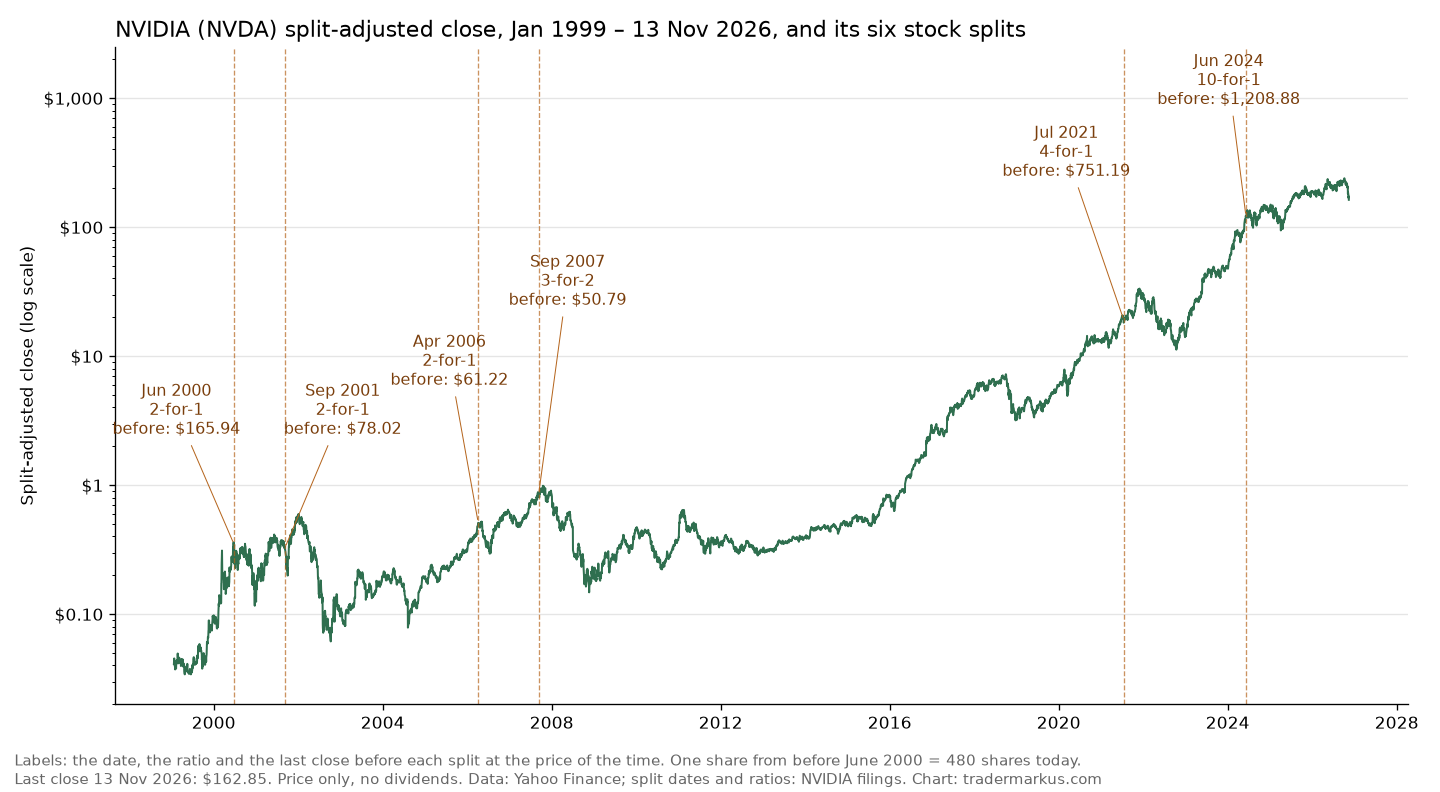
NVIDIA has split its stock six times: two-for-one in 2000, 2001 and 2006, three-for-two in 2007, four-for-one in 2021 and ten-for-one in June 2024. One share bought before the first split is 480 shares today. I checked what the stock did in the 12 months after each split. It was higher after only two of the six, while NVIDIA has been higher over about three quarters of all 12-month periods since its IPO.
When did NVIDIA split its stock?
These come from NVIDIA’s own filings: the annual and quarterly reports for 2000 and 2001, the press releases for 2006 and 2007, and the IRS Form 8937 tax notices for 2021 and 2024.
| Split | Ratio | Shares |
|---|---|---|
| June 2000 | 2-for-1 | 2 |
| September 2001 | 2-for-1 | 4 |
| April 2006 | 2-for-1 | 8 |
| September 2007 | 3-for-2 | 12 |
| July 2021 | 4-for-1 | 48 |
| June 2024 | 10-for-1 | 480 |
Shares: how many one share held before June 2000 had become. The 3-for-2 split gave one extra share for every two, with cash for fractions.
NVIDIA went public on 22 January 1999 at $12 a share. After the six splits that is $0.025 per share today, and the stock closed at $162.85 on 13 November 2026, about 6,500 times the IPO price before dividends.
The 2024 split: 10-for-1
NVIDIA announced it on 22 May 2024, together with its quarterly results and a higher dividend. The stock closed at $949.50 that day and at $1,037.99 the next, up 9.3%, but with the results out the same evening, that jump can’t be put down to the split. Shareholders of record on 6 June got nine extra shares for each one after the close on 7 June, and the stock traded split-adjusted from 10 June. The last close before the split was $1,208.88, and the first after it was $121.79.
NVIDIA gave its reason in the investor FAQ: the split was meant to make the stock “more accessible to employees and investors”. The same FAQ says the split doesn’t change the total value of anyone’s shares.
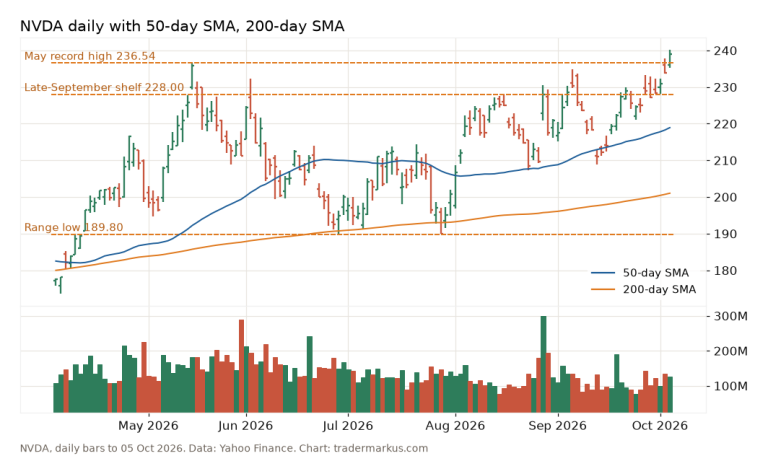
A year later NVIDIA was up 18.2% from the last pre-split close, against 15.1% for the Nasdaq-100. On the way it fell to $94.31 on 4 April 2025. It made its highest close so far, $239.24, on 6 October 2026, and on 13 November 2026 it was 34.7% above the last pre-split close, against 47.1% for the Nasdaq-100, so since the split the index has done better.
The 2021 split: 4-for-1
The board declared it on 21 May 2021, on condition that shareholders approved doubling the authorised shares from 2 billion to 4 billion, which they did at the June meeting. The new shares were distributed after the close on 19 July 2021. The last close before it was $751.19.
The stock kept rising into November 2021 and then fell 66.4% to its low close on 14 October 2022, $112.27 at the prices of the time. Twelve months after the split it was down 9.5%, which was still better than the Nasdaq-100 at −15.8%.
What did NVIDIA do after each split?
I took Yahoo Finance’s daily closes for NVIDIA and the Nasdaq-100 and measured the change from the last close before each split to 252 trading days later.
| Split | NVIDIA | Nasdaq-100 |
|---|---|---|
| June 2000 | +13.0% | −53.6% |
| September 2001 | −72.9% | −31.8% |
| April 2006 | −1.9% | +4.5% |
| September 2007 | −68.1% | −12.2% |
| July 2021 | −9.5% | −15.8% |
| June 2024 | +18.2% | +15.1% |
The change over the 12 months after each split (252 trading days), price only, from the last close before the split. Yahoo dates the 2001 split 10 September; NVIDIA’s quarterly report says the shares were handed out on 17 September, after the market reopened. Starting from 10 September gives −73.9% against −33.5%, so the picture is the same.
NVIDIA was higher after two of the six and beat the Nasdaq-100 after three. The median of the six was −5.7%. Over every 12-month period since the IPO, NVIDIA was higher 74.7% of the time, with a median of +40.3%. Two of the bad years fell in the 2001–02 bear market and in the run-up to the 2008 crash, which had nothing to do with the share count.
Six splits are far too few to call it a pattern either way, and I wouldn’t. What the numbers do show is that a split is not a buy signal. A company splits after a big rise, and the year after a big rise is sometimes another good year and sometimes the start of a long fall.
Why a split-adjusted chart can fool a backtest
On a split-adjusted chart NVIDIA closed at about 4 cents on its first trading day in 1999. The real close that day was $19.69. Every price before June 2024 has been divided by up to 480 to make the line continuous, which is right for the chart and right for returns.
It is wrong for anything that uses the price level itself. I ran into this in 2025: a momentum test that preferred stocks with a lower share price looked much better, and it turned out to be the splits. In adjusted data a low price years ago often means the stock went on to split, so the test was picking future winners it couldn’t have known about. Returns and indicators are fine on adjusted data. Price levels are not.
Will NVIDIA split again?
There is no announcement. The news from NVIDIA in mid-November 2026 was of another kind: on 12 November it said that Jensen Huang had resigned as chief executive, effective immediately, and that CFO Colette Kress is interim CEO. It said quarterly results would still come on 17 November, as planned. NVIDIA closed at $162.85 on 13 November 2026, 13% of the $1,208.88 it traded at before the last split, so the reason it gave in 2024 carries less weight today. The chart levels I’m watching are in my NVDA support and resistance post. For the same history on another stock, see Netflix’s stock splits.
FAQ
How many times has NVIDIA split its stock?
Six times since its 1999 IPO: 2-for-1 in June 2000, September 2001 and April 2006, 3-for-2 in September 2007, 4-for-1 in July 2021 and 10-for-1 in June 2024.
When was NVIDIA’s last stock split?
The 10-for-1 split in June 2024. Shareholders of record on 6 June 2024 received nine extra shares after the close on 7 June, and the stock traded split-adjusted from 10 June 2024.
How many shares would I have if I bought 1 share of NVIDIA at the IPO?
480 shares. The six splits multiply out to 2 × 2 × 2 × 1.5 × 4 × 10.
Does a stock split make NVIDIA a better buy?
No. The value of what you own is the same before and after, as NVIDIA’s own FAQ says. Twelve months after its six splits NVIDIA was higher twice.
A split changes the number on the screen, not the company. I look at the trend, not the share count.
Not financial advice. This is educational content, shared for information and entertainment only, and it is not a recommendation to buy or sell any asset. Backtests and past results do not guarantee future results, and the numbers or charts here may contain mistakes. Trading carries risk, including losing all the money you put in. Do your own research before you make any decision.