A poor man’s covered call is a covered call where a long-dated, deep in-the-money call option stands in for the 100 shares. You buy that call, sell a short-dated call above the price against it, and tie up a fraction of the money. On paper it is the covered call at a discount. On real SPY quotes at the 7 October 2026 close, not one of 69,654 possible combinations passed the two rules tastylive gives for setting it up properly.
What is a poor man’s covered call?
tastylive, the options trading network, describes it as “a long call diagonal debit spread that is used to replicate a covered call position”. In plain words there are two legs. First you buy a call that expires months or a year or more away, with a strike well below the current price, so it has a high delta and moves almost like the stock. Then you sell a call on the same stock that expires sooner, typically 30 to 60 days out, with a strike above the current price. That second leg is exactly what you sell in a normal covered call.
The difference is what covers the short call. In a covered call it is 100 shares. Here it is the long call, which is why the trade is often shortened to PMCC. Fidelity files the same structure under its textbook name, a long diagonal spread with calls: buy a longer-term call with a lower strike, sell a shorter-term call with a higher strike, pay a net debit. The appeal is the price tag, and the price tag is real.
A poor man’s covered call example with real SPY quotes
Rather than make up round numbers, I took the Cboe delayed quotes for SPY, the S&P 500 ETF, at the close on 7 October 2026. SPY closed at 777.22. Here is a textbook setup: buy the December 2027 690 call and sell the 20 November 2026 800 call. The long call was quoted 139.95 bid / 144.50 ask, the short call 5.67 / 5.70. You buy at the ask and sell at the bid, because that is where a normal order fills. One option covers 100 shares.
| Leg | Delta | Cost |
|---|---|---|
| Buy Dec 2027 690 | 0.80 | −$14,450 |
| Sell Nov 20 800 | 0.29 | +$567 |
| Net debit | 0.51 | $13,883 |
| 100 shares | 1.00 | $77,722 |
So $13,883 buys a position that, for now, moves like about 51 shares. Buying 51 shares would cost $39,638. The $567 premium is 4.1% of the money at work for 44 days, against 0.73% when you sell the same call against 100 shares. That is the whole sales pitch in one line, and the numbers are correct.
Time decay works for you too, at least on the day I measured it. The short call’s theta was −0.1227, so it lost about $12.27 a day in value, which is your gain. The long call lost about $4.01 a day. Net, roughly $8 a day while SPY sits still. Look at the spread on the long call, though: 139.95 bid, 144.50 ask. That is $455 per contract you give up the moment you buy, before SPY has moved a cent.
The two PMCC rules, and why my example fails both
tastylive is clear that a bad setup can lose money even when SPY moves your way. Their two checks, in their words: the near-term option you sell should be “equal to or greater than” the extrinsic value of the long call, and “the total debit paid is not more than 75% of the width of the strikes”. Extrinsic value is the time value: what the option costs above what it would be worth if exercised today.
My example fails both. The 690 call is 87.22 in the money, so of its 144.50 ask, 57.28 is time value. The short call brings in 5.67, about 10% of that. The strike width is 800 − 690 = 110, and 75% of it is 82.50. I paid 138.83, which is 126% of the width.
The width rule matters most when SPY runs. If SPY is far above both strikes when the short call expires, the spread is worth $110 plus whatever time value the long call still has. You paid $138.83. So to break even on a big rally, the long call has to keep at least $28.83 of time value, and the further in the money it goes, the less time value an option tends to hold. In other words, you can be right about the direction and still lose. That’s what the rule protects against.
I checked every combination: 0 pass both rules
Maybe I just picked badly. So I ran the whole chain: every SPY call expiring between December 2026 and January 2028 with a delta of 0.70 to 0.95 (893 long calls), against every call expiring 30 to 60 days out with a delta of 0.15 to 0.40 (78 short calls, expiring 6, 13, 20 and 30 November). That makes 69,654 valid pairs.
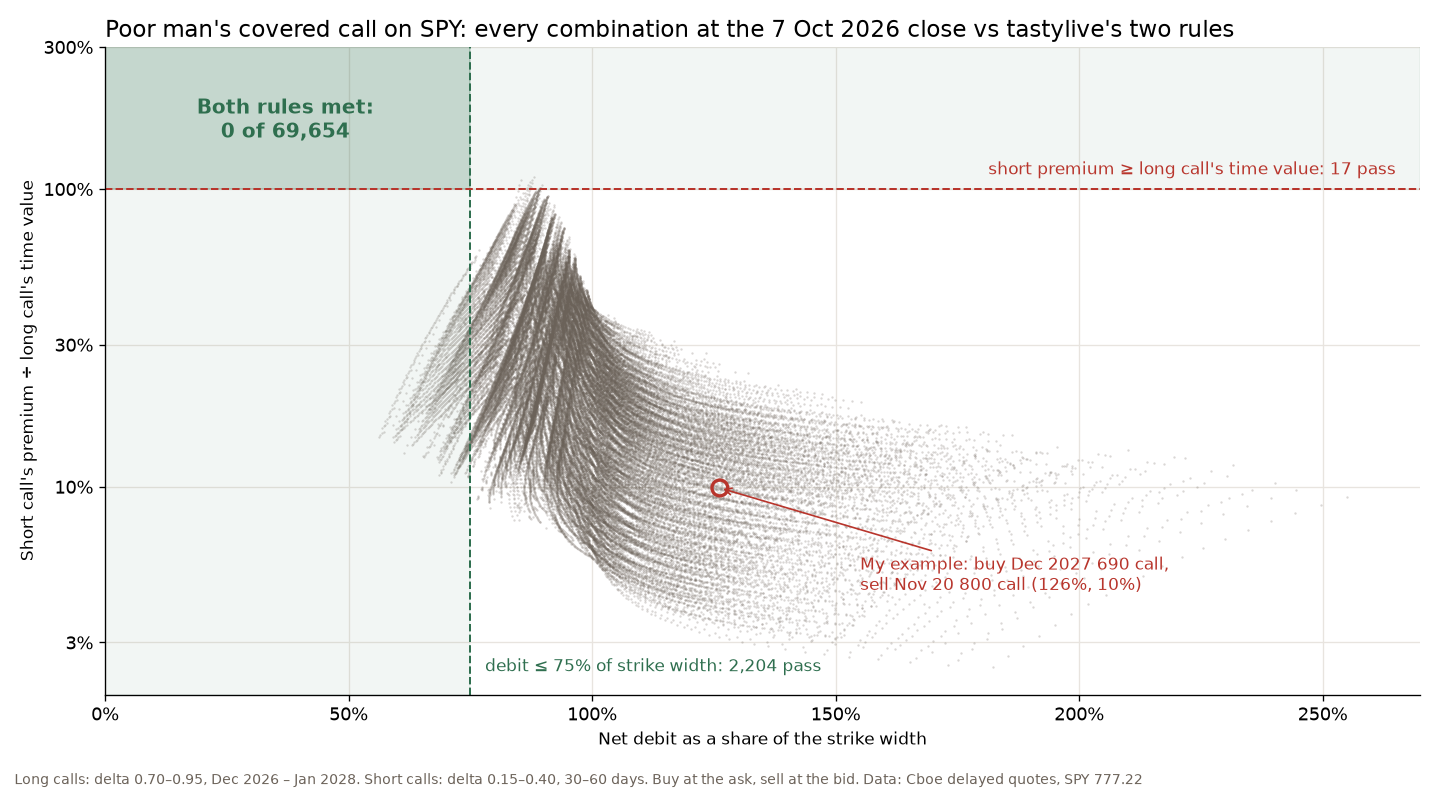
- Debit no more than 75% of the strike width: 2,204 pass.
- Short premium at least the long call’s time value: 17 pass. All 17 use a long call expiring in December 2026, two to three months away. That is not a LEAPS, it is a short-term call with a delta near 0.95.
- Both rules: 0.
With a true LEAPS, the December 2027 and January 2028 calls (7,800 pairs), not a single pair met even the 75% rule (the best was 96% of the width), and the short premium never covered more than 31% of the long call’s time value. Using mid prices instead of the bid and ask doesn’t save it: 3,194 and 374 pass the rules on their own, 0 pass both. I ran the same scan on the 6 October close a day earlier and got the same answer, 0.
There is a simple reason. If the short premium covers the long call’s time value, the debit is at most the long call’s intrinsic value, SPY minus its strike. For that to be under 75% of the width, the short strike has to sit above the price by at least a third of how deep in the money the long call is. With the 690 call, that means a short strike of 806.29 or higher. The first November 20 strike above that, 810, paid $3.10, against $57.28 of time value. SPY’s 30-day implied volatility was 12.4% that day. In a calm market, out-of-the-money calls are cheap, and that is exactly what this trade needs to sell.
So my conclusion is narrow: on these two days’ quotes, the textbook PMCC on SPY could not meet its own setup rules. That doesn’t mean never. When implied volatility is higher, short calls pay more, and on a single stock with richer options the numbers will look different. Run the two checks every time; they take a minute.
How risky is a poor man’s covered call?
Fidelity puts the maximum loss of the long diagonal at the net cost of the spread, my $13,883. The leverage that made the premium look like 4.1% works the other way too. With 51 deltas on $13,883, a small fall in SPY at first hits this money almost three times as hard, in percentage terms, as the same fall hits 100 shares on $77,722. And the long call has an expiry date, which shares don’t. If SPY falls and stays down, time works against the leg you own. tastylive’s own page adds that “each expiration acts as its own underlying, so our max loss is not defined”, and their max-profit estimate depends on how much time value the long call still has when the short call expires, which nobody knows in advance.
Then there is assignment. Fidelity notes that short calls assigned early are generally assigned the day before an ex-dividend date, and that in-the-money calls whose time value is less than the dividend are the likely ones. If that happens here, you are suddenly short 100 shares while your long call is still open. You can exercise the long call, but then you throw away its remaining time value, so the better fix is usually to sell it. Either way it is a mess you want to see coming, and the calendar of dividend dates is part of the trade.
Sizing is the same problem as with any leveraged position. I would size it by what I can lose, not by how many contracts the account allows, the same way I size a stock trade around the stop.
Poor man’s covered call vs covered call: which one I’d use
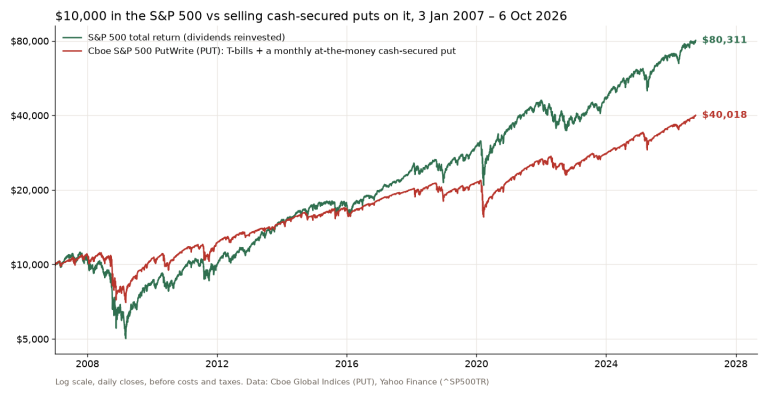
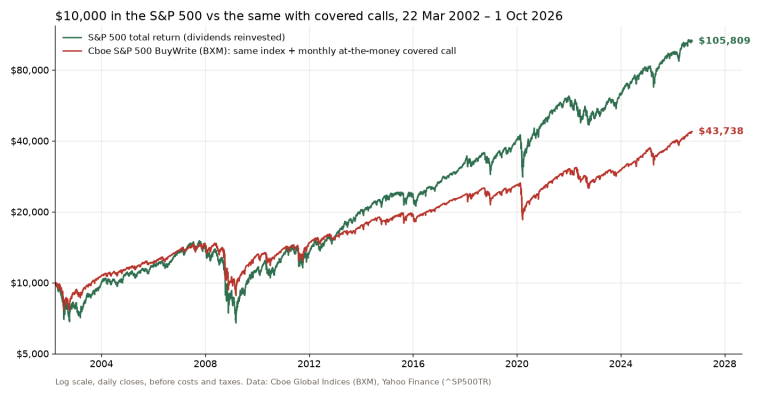
When I tested covered calls on 24 years of S&P 500 data, the strategy gave up a lot of return for lower volatility. Selling cash-secured puts looked similar. Both are slow, boring and fully funded, which is their strength. The PMCC keeps the capped upside of a covered call and adds leverage and an expiry date. And on SPY in a quiet market, it couldn’t pass its own setup rules.
If you want the PMCC, I’d start by checking the two rules on today’s chain before anything else, and I’d read up on how option prices react to volatility. Sheldon Natenberg’s Option Volatility and Pricing is the book for that. For my own money, the covered call on shares I’d hold anyway is the simpler trade, and the one I understand when it goes wrong.
FAQ
Is a poor man’s covered call better than a covered call?
It is cheaper, not better. On 7 October 2026 it cut the money needed on SPY from $77,722 to $13,883, but it carries leverage, an expiry on the long leg and a wide spread, and none of the 69,654 SPY combinations passed both of tastylive’s setup rules that day.
What happens if the short call gets assigned?
You become short 100 shares while still holding the long call. You can buy back the shares and keep the long call, or sell the long call. Exercising it works too but throws away its time value. Early assignment usually happens just before an ex-dividend date.
What delta should the long call have?
tastylive only says a high delta, so the long call moves closely with the stock. My scan used 0.70 to 0.95, and my example was 0.80. tastylive also notes that the deeper in the money the long call is, the easier the extrinsic value rule is to meet, because you pay for less time value.
The poor man’s covered call is a leveraged covered call with a nicer name. Check the debit against the strike width and the short premium against the long call’s time value, and if the chain won’t give you both, don’t force the trade.
Not financial advice. This is educational content, shared for information and entertainment only, and it is not a recommendation to buy or sell any asset. Backtests and past results do not guarantee future results, and the numbers or charts here may contain mistakes. Trading carries risk, including losing all the money you put in. Do your own research before you make any decision.