FOMO trading means buying because a price is running away from you, not because your plan says buy. The fear of missing out makes you enter late, with too much size and no stop. My data on 34 big Bitcoin rallies since 2014 shows that buying after a strong week was not the real mistake. The mistake is everything a FOMO trader does around that entry.
What is FOMO in trading?
FOMO stands for “fear of missing out”. In trading it is the feeling you get when a stock, a coin or an index moves hard without you, everybody in your feed is posting gains, and buying right now feels safer than watching. The trade is not on your list, there is no level on your chart, but the pain of missing the next 20% is bigger than the fear of losing. So you click buy, usually near the top of the day’s range.
It is not a rare problem. In the FINRA Foundation and CFA Institute Gen Z and Investing report (May 2023), half of U.S. Gen Z investors said they had made an investment driven by FOMO. Older research says the same about everyone else. Brad Barber and Terrance Odean showed in “All That Glitters” (Review of Financial Studies, 2008) that individual investors are net buyers of attention-grabbing stocks: stocks in the news, with unusual volume or an extreme one-day move. Institutions were the least affected. In plain words, the crowd buys what is loud.
Is chasing a rally really a mistake? 34 Bitcoin rallies since 2014
The usual advice is “never chase”. I wanted to see if the numbers agree, so I took Bitcoin, the market where FOMO is loudest. I used daily closes from Yahoo Finance, 17 September 2014 to 2 October 2026, and marked every day when Bitcoin closed at least 20% above its close seven days earlier. That is the week when everybody you know suddenly asks about crypto. To keep one rally from counting many times, the next signal only counted 30 days later. That gave 34 cases. For each one I measured where Bitcoin was 30 days later and the deepest drop along the way.
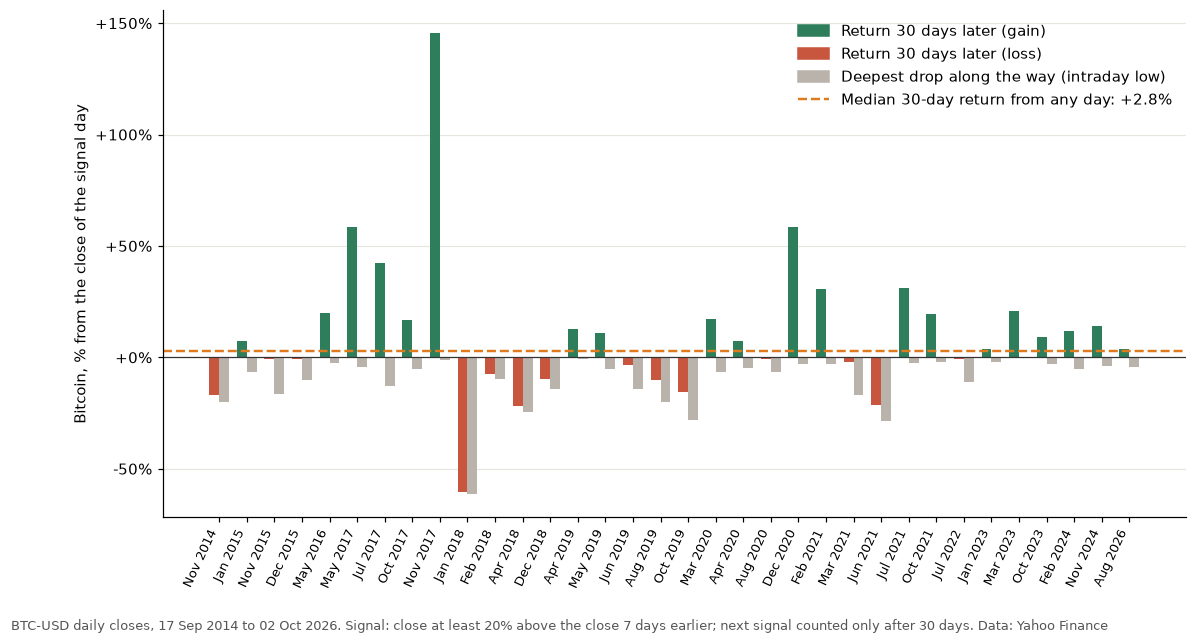
The result surprised me a little. After a 20% week, Bitcoin was higher 30 days later in 20 of the 34 cases. The median return was +7.3%, against +2.8% for any random day in the same years. Strength tended to be followed by more strength, which is simply momentum. The deepest drop along the way was not worse either: a median of −5.9% after the signal days, against −7.8% from any day.
| 30 days later |
After a 20% week |
Any day |
|---|---|---|
| Median return | +7.3% | +2.8% |
| Share higher | 59% (20 of 34) |
57% |
| Median deepest drop |
−5.9% | −7.8% |
| Worst case | −60.3% (Jan 2018) |
The S&P 500 says the same thing more quietly. Since 1970 the index has had 89 such weeks by my count (up at least 5% in five sessions, counted once per 20 sessions). Twenty sessions later the median return was +1.5%, against +1.1% for any day. So the honest answer is no: buying after a strong move is not a mistake in itself. Trend followers do it on purpose. The difference is that they do it with a plan.
Why FOMO trading still loses money
Look at the grey bars on the chart again. In 13 of the 34 cases Bitcoin fell at least 10% below the signal day’s close at some point in the next 30 days. The worst was the week to 6 January 2018. Bitcoin had closed at 12,952 on 30 December, bounced to 17,527 a week later, and the crowd was back in. Thirty days later it closed at 6,955. That was −60.3%, and the record close of 19,497 from 16 December 2017 was already behind it.
That is where FOMO hurts, not in the average case. You buy with too much money because the move “can’t fail”, without a stop because there is no level, and then the first −10% feels like a disaster. So you sell near the low, and two weeks later you watch it run again. The average return after a rally belongs to the trader who sits through the drop with a size they can afford. The FOMO trader rarely is that trader. I made the same point in Is day trading gambling?: a trade without a stop set before you click and a size you can afford to lose is a bet.
How to stop FOMO trading: 6 rules
1. No level, no trade
Before you buy, write down where you are wrong. If you can’t point to a level on the chart, a swing low, a moving average, a breakout point, you are not trading a setup, you are reacting to a feeling. Wait for the next pullback to a level and decide there.
2. Size the position from the stop, not from the excitement
Say the account is $10,000 and you risk 1% per trade, $100. Bitcoin closed at 78,335 on 21 August 2026 after a 24% week. A stop 10% lower sits at about 70,500, so the risk is 7,834 per coin. $100 ÷ 7,834 = 0.0128 BTC, a position of about $1,000, a tenth of the account. That feels small when everyone is making money. It is supposed to. And note: a 10% stop would have been touched in 13 of my 34 cases, so a wider stop needs an even smaller position. More on placing it in stop loss trading. Too much size for the loss limit is also one of the usual ways traders lose a prop firm challenge, which I wrote about in how prop firms make money.
3. Don’t buy the bar that made you want to buy
The candle that triggers FOMO is usually the biggest one of the week, and you would be buying its top. A simple rule: no entry on the day of a move larger than the stock’s or coin’s normal daily range. If it is still a good trade tomorrow, it will still be there tomorrow, maybe at a better price.
4. Have a list before the market opens
FOMO lives in the gap between “I had no plan” and “something is moving”. A short watchlist with levels, made before the open, closes that gap. If a ticker is not on it, it is not a trade today. My weekly levels page is one example of writing the levels down before the week starts. I learned this in 2018, when I ignored my own notes on a weak sector because I was in a buying mood, and wrote about it in Trade your system, not the news.
5. Turn off the scoreboard
Barber and Odean’s point was that attention drives buying. So reduce the attention. Mute the coin and stock accounts that post screenshots of gains, close the “top movers” tab, and look at your own chart instead. Other people’s P&L is the most expensive information on the internet. When the urge comes anyway, the exercise from Gary Dayton’s Trade Mindfully helps: notice the thought of fear or greed, let it go and bring your attention back to your own chart.
6. Write down every FOMO trade
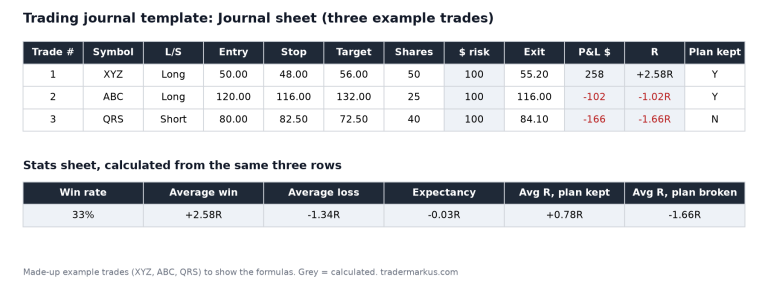
Mark them in your journal: “entered without a plan, because it was running”. After 20 trades, compare them with your planned ones. In my experience that comparison cures more FOMO than any book. The free trading journal template has the columns for it, “Followed plan? (Y/N)” and “Feeling before entry”, and its Stats sheet compares the average R of both groups for you.
FAQ
What does FOMO mean in trading?
FOMO means fear of missing out. A trader with FOMO buys because the price is moving fast and they don’t want to miss more of it, not because their strategy gave a signal. It usually shows up as a late entry, a position that is too big and no stop.
Is FOMO bad for trading?
The entry itself is not always bad. In my Bitcoin data, buying after a 20% week did better on average than buying on a random day. What makes FOMO bad is the rest of the trade: no exit plan, too much size and selling in panic during the normal drop that follows.
Is FOMO trading the same as momentum trading?
No. Both buy strength, but a momentum trader has rules for what to buy, how much and where to get out, and follows them in every trade. A FOMO trader buys what is loud today and makes up the rest as they go. Same entry, very different outcome.
How do I stop FOMO in crypto?
Crypto trades all weekend and moves 20% in a week, so the triggers are stronger. The same rules work: a level before the entry, size from the stop, a written watchlist, and fewer screens with other people’s gains on them.
The market will always have another rally you are not in. I have missed hundreds of them and I’m still here. Missing a move costs nothing; chasing it with the rent money can cost a lot.
Not financial advice. This is educational content, shared for information and entertainment only, and it is not a recommendation to buy or sell any asset. Backtests and past results do not guarantee future results, and the numbers or charts here may contain mistakes. Trading carries risk, including losing all the money you put in. Do your own research before you make any decision.