A cash-secured put means you sell a put option and keep enough cash in the account to buy the 100 shares if the stock falls below the strike. You get paid now for promising to buy later. Cboe has tracked this on the S&P 500 every day since 2007: selling puts fell much less in 2008 and 2022, but $10,000 grew to $40,018 against $80,311 for simply holding the index.
Selling puts gets pitched as “getting paid to buy stocks at a discount”. That is half true. The other half is what you give up, and it is easy to miss because the premium lands in your account on day one. So below are the mechanics, a worked example with round numbers, and then almost 20 years of real data on what the strategy did against the plain index.
What is a cash-secured put?
A put option gives its buyer the right to sell 100 shares at the strike price until the option expires. When you sell that put, you take the other side: you collect the premium up front, and you take on the obligation to buy the shares at the strike if the buyer uses the right. “Cash-secured” means the full purchase price, strike times 100, sits in your account as cash the whole time. A $50 strike ties up $5,000. Selling a put without that cash behind it is a naked put, and it is margin, not a cash trade.
At expiration there are two outcomes. If the stock is above the strike, the put expires worthless and you keep the premium. If it is below the strike, you will most likely be assigned: you buy 100 shares at the strike, whatever the market price is that day, and you still keep the premium. Fidelity’s cash-secured put explainer goes through the same steps.
A cash-secured put example with round numbers
These are made-up round numbers to show the arithmetic, not a real quote. A stock trades at $100. You sell one put with a $95 strike that expires in a month, for $2.00 per share. That is $200 in your account today, and $9,500 has to stay there as cash until expiry. Here is the result at expiration, next to simply buying 100 shares at $100:
| At expiry | Shares | Put sold |
|---|---|---|
| $80 | −$2,000 | −$1,300 |
| $93 | −$700 | $0 |
| $95 | −$500 | +$200 |
| $100 | $0 | +$200 |
| $120 | +$2,000 | +$200 |
Anywhere above $95 the answer is the same: $200 and not a cent more. That is the maximum profit, about 2.1% on the $9,500 for the month. Below $95 you are assigned and own the shares at $95, so your breakeven is the strike minus the premium, $93. At $80 you are down $1,300. If the stock goes to zero you lose $9,300. The put seller does lose less than the buyer of the shares in every row under $100, and that is the real appeal. The price is the bottom row: when the stock runs to $120, the shareholder makes $2,000 and you make $200.
The cash also earns interest while it sits there, if your broker pays it. Don’t skip that line on the statement; over the years it is a large part of the return, as the data below shows.
What 19 years of S&P 500 data say about selling puts
One example proves nothing, so I went to the Cboe S&P 500 PutWrite Index (PUT). It does exactly what this post describes, by the rules, every month: it sells at-the-money S&P 500 puts, usually on the third Friday, and holds the cash in one-month and three-month Treasury bills. Cboe publishes the daily values back to 3 January 2007 (the index launched on 20 June 2007, so the first months are back-tested). I compared them with Yahoo’s S&P 500 total return index, which includes dividends, on the same 4,971 trading days up to 6 October 2026.
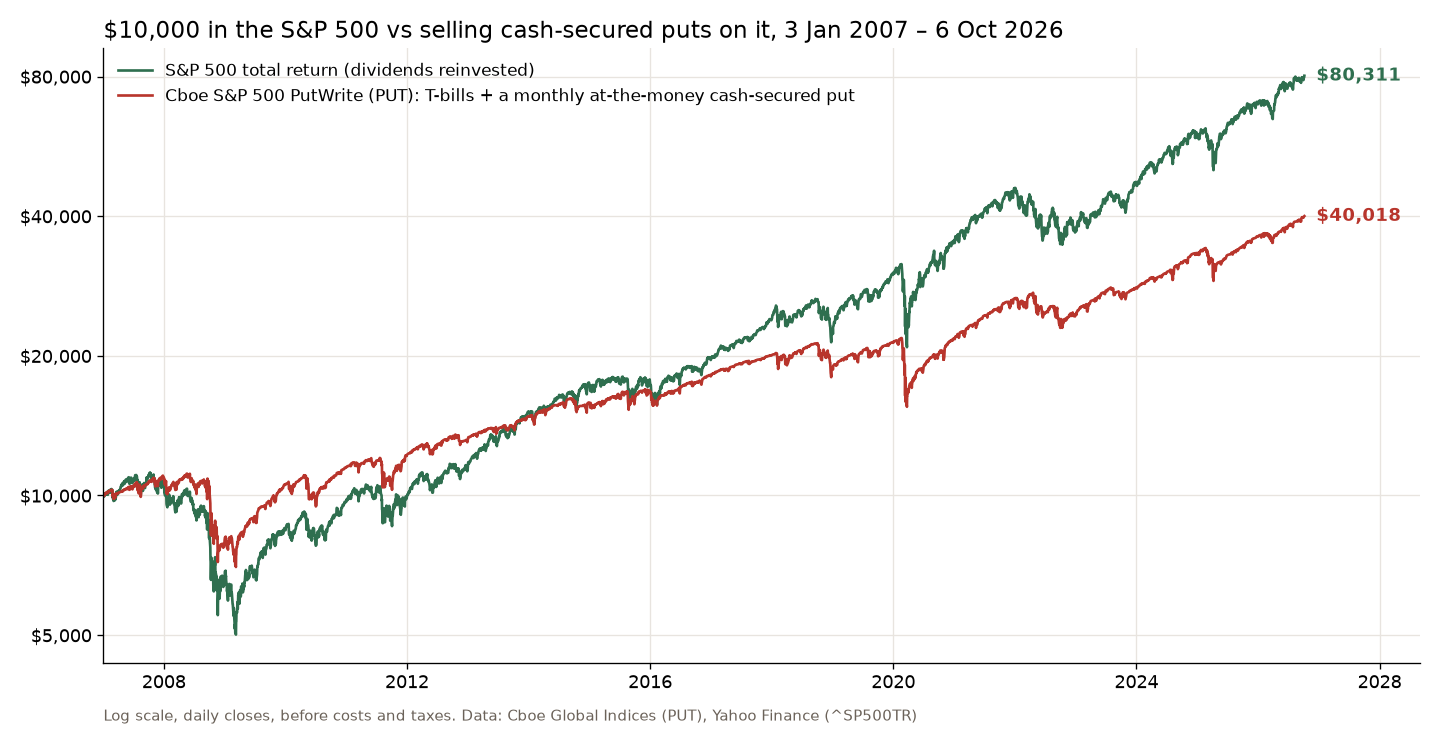
| 2007–2026 | Puts (PUT) | S&P 500 |
|---|---|---|
| $10k became | $40,018 | $80,311 |
| Per year | 7.27% | 11.12% |
| Volatility | 13.8% | 19.6% |
| Worst fall | −37.1% | −55.3% |
The calmer ride is real. Daily swings were about 30% smaller, and the worst fall was −37.1% (19 May 2008 to 9 March 2009) against −55.3% for the index. The put seller also got back to its pre-crisis high on 4 November 2010, almost a year and a half before the S&P 500 did on 2 April 2012. But the gap at the end is the part that matters. Holding the index ended with twice the money.
My numbers are daily closes to 6 October 2026. Cboe’s own PUT factsheet uses month-end values to 31 August 2026 and shows the same picture: 7.1% a year with a −32.7% worst fall, against 11.0% and −50.9% for the S&P 500. Its calendar-year returns for 2011–2025 match mine to the decimal.
When selling puts beat the market, and when it didn’t
Year by year the pattern is plain. In 18 full calendar years, 2008 to 2025, selling puts came out ahead in 5: 2008, 2009, 2011, 2015 and 2022. Those are falling or flat years, plus the 2009 rebound. In 2022 the PUT index lost 7.7% while the S&P 500 lost 18.1%. In a strong year it is the other way round: 2013 gave the index 32.4% and the put seller 12.3%.
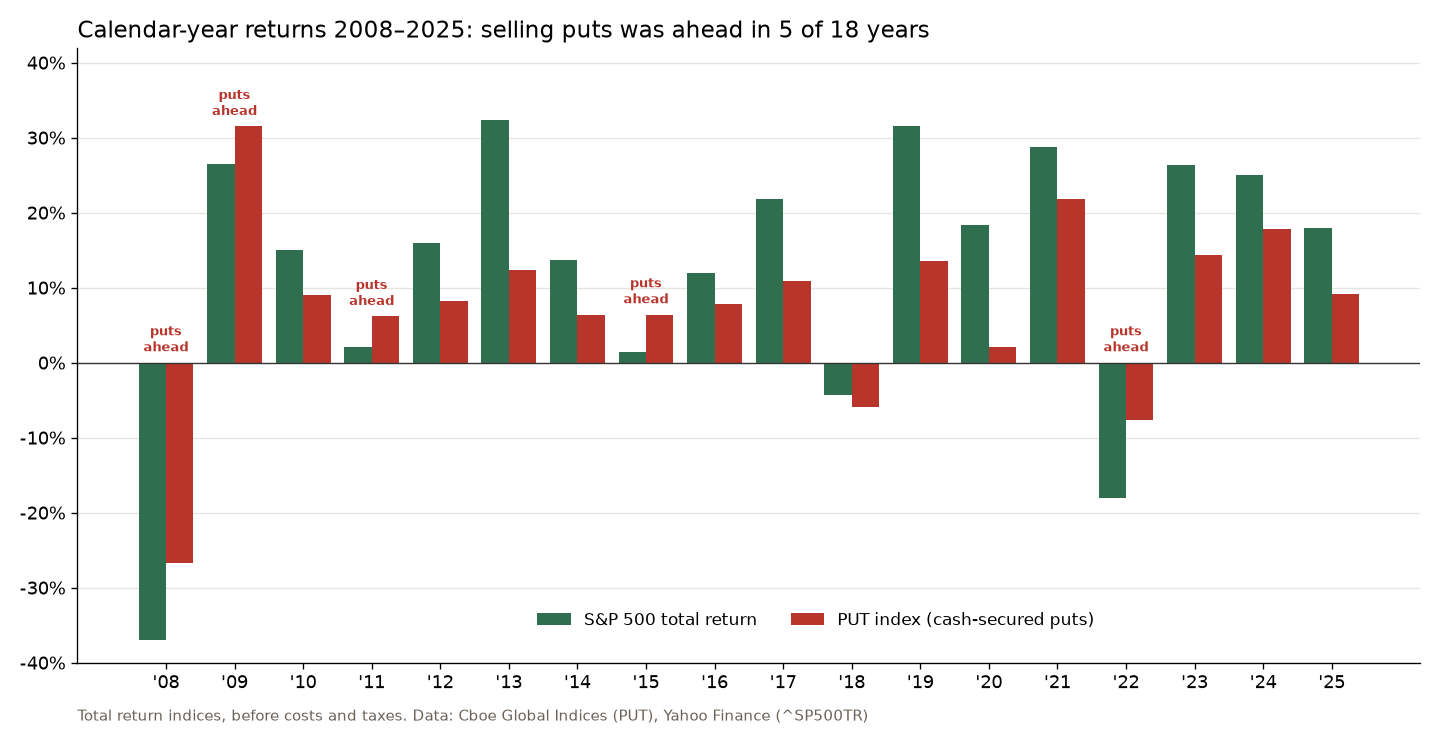
2020 is the year to look at if you think selling puts protects you in a crash. The PUT index fell 28.9% from February to 23 March, only a little less than the index’s 33.8%. Then the market shot back up, and the put seller, capped at one month’s premium at a time, could not keep up. The S&P 500 was back at its high on 10 August 2020. The PUT index needed until 7 January 2021, and it finished the year up 2.1% against 18.4%. A fast crash followed by a fast recovery is the worst case for this strategy: you take most of the fall and miss most of the rebound.
Over any five years the odds were poor too. Of 3,717 rolling five-year windows since 2007, selling puts was ahead in 8.1%. This year, to 6 October, it is up 10.8% against 15.2%. All of these numbers are before commissions, bid-ask spreads and taxes, and an index rolls one contract a month without ever getting nervous. A real account does worse on all three counts.
Cash-secured put vs covered call
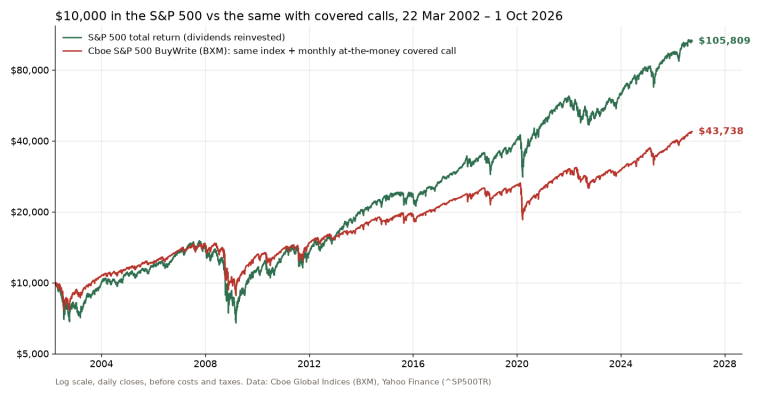
On paper they are near twins. A covered call is “own the shares, sell a call”; a cash-secured put is “hold the cash, sell a put”. At the same strike both give you a small, capped gain and most of the downside. The data agree: over the same days since 2007 the PUT index and Cboe’s covered-call index, BXM, moved in the same direction on 92% of days (4,560 of 4,967). PUT made 7.27% a year and BXM 6.09%. I tested the covered call side, with 24 years of data, in Covered call: What 24 years of S&P 500 data say about it.
The practical difference is the starting point. The put seller starts in cash and might end up owning the stock. The covered call writer starts with the stock and might end up in cash. Run them one after another, sell puts until you are assigned, then sell calls on the shares until they are called away, and you have what options forums call the wheel. It is the same trade shape twice, with the same trade-off.
Does Warren Buffett sell put options?
He has, but not like this. In his 2008 letter to Berkshire shareholders, Buffett described $37.1 billion of put contracts on four stock indices (the S&P 500, FTSE 100, Euro Stoxx 50 and Nikkei 225), due between 2019 and 2028, for which Berkshire had received $4.9 billion in premiums. At the end of 2008 they showed a $5.1 billion mark-to-market loss. Those were very long-dated index puts that only settle at expiry, and Berkshire had to post very little collateral against them. A one-month put on a single stock with the full cash set aside is a different trade, and quoting Buffett doesn’t make it a better one.
How I would use a cash-secured put
I look at a short put as a limit order that pays you to wait. That is the one use that makes sense to me: there is a stock I want to own, and a price I would happily buy it at. I take the strike from the chart, a support level where I would put a buy order anyway. If the price comes down, I get the shares a bit below that level. If it doesn’t, I keep the premium and I don’t care much that I missed the move, because I wasn’t going to chase it.
What I would not do is sell puts for “income” on whatever pays the fattest premium. A fat premium means the market expects a big move, and the put seller is the one who pays for it. The size rule is simple: the position is the strike times 100, not the $200 premium. A $95 put is a $9,500 position, and the same position sizing rules as for a stock apply. Taleb’s point about the option seller who earns a little for a long time and then loses a lot in one go is in my Fooled by Randomness review, and the 2020 numbers above are that point in practice.
FAQ
Can you lose money on a cash-secured put?
Yes. The premium only lowers your buy price. If the stock falls further than the premium below the strike, you are losing money, and if it goes to zero you lose the strike minus the premium. In 2008 the PUT index, which sells puts on the whole S&P 500, lost 26.8%.
What happens if a cash-secured put is assigned?
You buy 100 shares per contract at the strike price, paid with the cash you set aside, and you keep the premium. From then on you simply own the stock. Many traders then sell covered calls on those shares; the risk is the same as owning them.
Is a cash-secured put a good strategy?
It is a calmer way to hold stocks, not a better one. On the S&P 500 from 2007 to 2026 it fell less and swung less, but returned 7.27% a year against 11.12%. It fits someone who wants to buy a stock lower and would be glad to own it at the strike.
How much money do you need for a cash-secured put?
The strike price times 100 for each contract. A $20 strike needs $2,000, a $200 strike needs $20,000. The premium you receive is yours, but the full strike amount stays locked as collateral until the put expires, is closed or is assigned.
Selling a put is a good way to buy a stock you already want at a price you already like. As a way to get paid for nothing, it looks great right up to the month it doesn’t.
Not financial advice. This is educational content, shared for information and entertainment only, and it is not a recommendation to buy or sell any asset. Backtests and past results do not guarantee future results, and the numbers or charts here may contain mistakes. Trading carries risk, including losing all the money you put in. Do your own research before you make any decision.