Tax loss harvesting means selling an investment at a loss so the loss can cut your tax bill. The US rules are short: losses offset your gains, up to $3,000 of what is left can reduce your other income, and you can’t buy the same thing back within 30 days. The part people argue about is timing. Does the year’s loser bounce in January once the selling is over? I checked every December since 1999 on the nine original S&P 500 sector funds. The worst sector beat the S&P 500 in 14 of 27 years: a coin flip.
This is not tax advice, and I am not a tax adviser. The rules below come from the IRS’s Publication 550 (2025 edition, the current one), and the data part is my own test.
What is tax loss harvesting?
You sell something that is worth less than you paid, and you book the loss. In the IRS’s words, “if your capital losses are more than your capital gains, you can claim a capital loss deduction.” So the losses first cancel out gains you took during the year, and what is left over can be deducted from other income.
That deduction has a cap: the lesser of $3,000 ($1,500 if you are married and file a separate return) or your total net loss. Anything above the cap isn’t lost. You “carry over the unused part to the next year” and use it then.
The idea is simple. The catch is that most people want to keep the investment, and that is where the wash sale rule comes in.
The wash sale rule
A wash sale happens when you sell at a loss and, within 30 days before or after the sale, you buy substantially identical stock or securities, get them in a fully taxable trade, buy an option to buy them, or buy them for your IRA or Roth IRA. If your spouse or a corporation you control buys them, that counts too.
The loss isn’t gone, it is postponed. The disallowed loss is added to the cost of the new shares, and the holding period of the old shares carries over. The IRS example: you buy 100 shares for $1,000, sell them for $750, and within 30 days buy 100 shares of the same stock for $800. You can’t deduct the $250 loss, and your basis in the new shares is $1,050. The IRA case is the exception: there, the loss is not added to the new shares’ cost.
What counts as “substantially identical” depends on “all the facts and circumstances.” The IRS says the stock of one corporation is ordinarily not substantially identical to the stock of another. It does not say anything about two funds that track the same index, so I wouldn’t assume either way.
Does the December loser bounce back?
The popular theory: everyone dumps the year’s losers in December for the tax loss, the selling ends, and in January the losers bounce. If that were reliable, you could harvest the loss and buy the loser back cheaper after 30 days, or simply buy what others are dumping.
Testing it on single stocks honestly needs the list of what was in the index each year, including the companies that later went bust. Without it, the test only sees the survivors and flatters the losers. So I used funds that never disappeared: the nine Select Sector SPDR funds (materials, energy, financials, industrials, technology, consumer staples, utilities, health care and consumer discretionary), which all launched together in December 1998.
The rules: each year, rank the nine by their return since the start of the year at the last close on or before 15 December. Take the worst one, the one you would harvest, and measure its return from there to the last close of January, dividends included. Compare it with SPY, the S&P 500 fund, over the same days. 27 Decembers, 1999 to 2025.
| Mid-Dec to end of Jan |
Beat the S&P 500 |
|
|---|---|---|
| Worst | +1.00% | 14 of 27 |
| 3 worst | +1.72% | 17 of 27 |
| 3 best | +1.08% | 13 of 27 |
| SPY | +0.96% |
These are averages, so one big year can move them. The best number here is the three worst sectors as a group: ahead of the S&P 500 in 17 of 27 years. But the three worst sectors beat the three best in only 13 of the 27 years, and the split by halves told the same story: 6 of 14 years from 1999 to 2012, 7 of 13 from 2013 to 2025. The losers as a group did a little better than the index, and no better than the winners. With 27 years of data, I wouldn’t build a trade on either.
There was another surprise. In 11 of the 27 years even the worst sector was up for the year by mid-December, so at the sector level there was nothing to harvest. In the 16 years when it was down, it made +0.90% to the end of January against +0.82% for the S&P 500, and beat it 9 times. In the 12 years it was down more than 10%, it made +0.65% against +0.25%, ahead in 7.
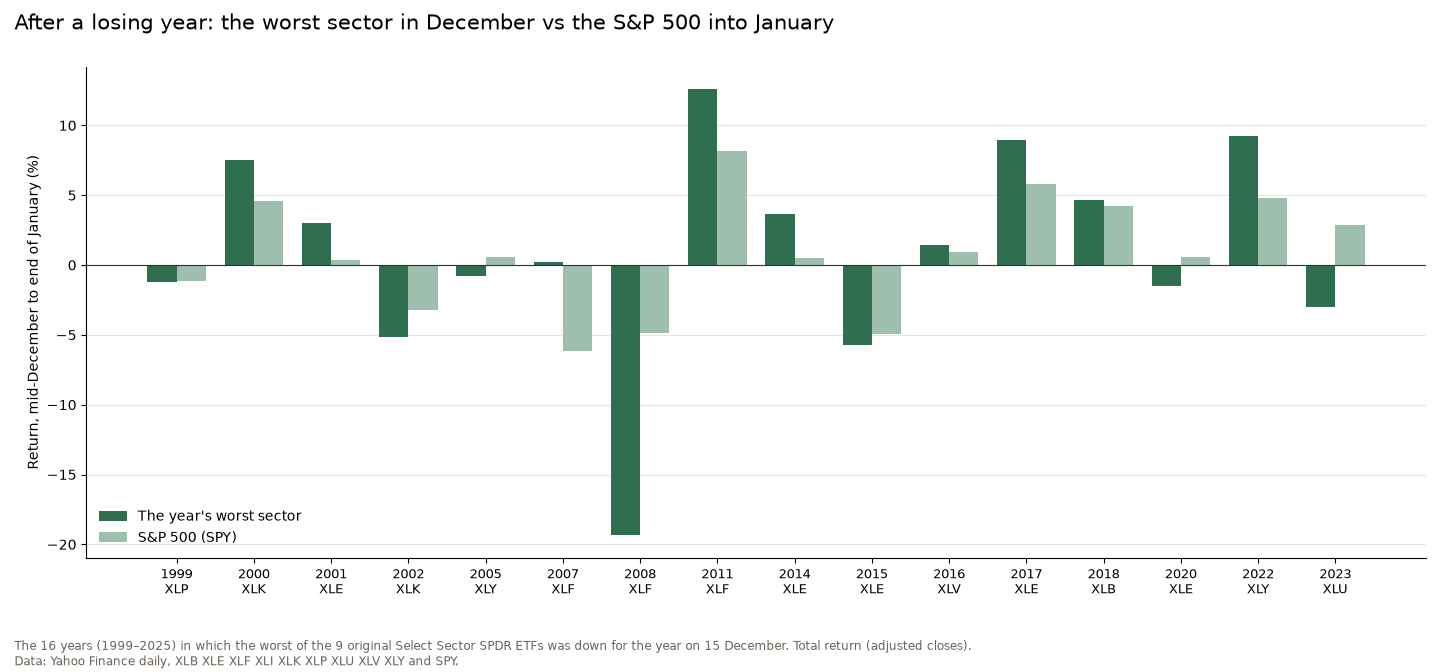
The extremes show why the average means little. Financials were down 58.7% for the year in mid-December 2008 and fell another 19.4% by the end of January. Three years later they were down 20.4% and bounced 12.6%. Consumer discretionary was down 32.9% in mid-December 2022 and gained 9.3%. Same setup, opposite outcomes.
One claim I can’t check: that the January bounce is much stronger in single stocks than in sectors. Maybe it is. Without a survivorship-free list of stocks I’d only be testing the ones that made it, so I’m leaving it open.
What I take from it
Harvesting a loss is a tax decision, not a trade. The sector that was worst in December was about as likely to beat the market in January as not, so selling it in the hope of buying it back cheaper is a guess, and so is holding it for a bounce.
That makes the decision simpler. If the loss is real and you would sell it anyway, the tax rules decide the timing, not the chart. If you want to stay invested while the 30 days run, that means buying something that isn’t substantially identical, and the test says its return against the one you sold is a coin flip too.
The bigger risk is the opposite habit: holding a loser all year because selling feels like admitting a mistake. As I wrote in 2020, it is OK to be wrong, it is not OK to stay wrong, and a stop loss makes that decision before it becomes a tax question. A calendar saying isn’t a trading rule either. When I looked at sell in May and go away, the “weak summer” showed up in one 20-year window of data and not in a later one.
FAQ
Is tax loss harvesting worth it?
If you have gains to offset, or you can use the $3,000 deduction against other income, the tax saving is real. It is not a way to beat the market: in my test the worst December sector beat the S&P 500 in 14 of 27 years.
How much can you tax loss harvest in a year?
Losses first offset your capital gains. If they are bigger than your gains, up to $3,000 of the net loss ($1,500 if married filing separately) can be deducted from other income each year, and the rest carries over to the next year.
Is tax loss harvesting legal?
Yes. Deducting a capital loss is part of the tax rules. The wash sale rule only stops you from deducting the loss now if you buy substantially identical securities within 30 days before or after the sale; the loss is then added to the cost of the new shares.
What is an example of tax loss harvesting?
The IRS’s own example of the wash sale rule: buy 100 shares for $1,000, sell them for $750, and buy them back for $800 within 30 days. The $250 loss can’t be deducted now, and the new shares’ cost becomes $1,050. Wait more than 30 days before buying back, or buy something not substantially identical, and the $250 loss counts.
Tax rules change and depend on your situation, so check the current IRS publication or ask a tax professional before you act.
Not financial advice. This is educational content, shared for information and entertainment only, and it is not a recommendation to buy or sell any asset. Backtests and past results do not guarantee future results, and the numbers or charts here may contain mistakes. Trading carries risk, including losing all the money you put in. Do your own research before you make any decision.