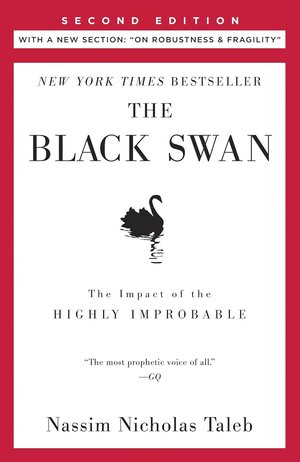
The Black Swan is Nassim Nicholas Taleb’s book about the rare events that nobody predicts, that change everything, and that everybody explains afterwards. For a trader it is mostly a book about one mistake: using the bell curve to measure risk in markets where a single day can do more damage than the previous ten years. I checked that claim on the S&P 500, and the numbers are on his side.
What The Black Swan is about
Taleb defines a black swan by three things: it is a surprise, it has a huge impact, and after it happens we come up with a story that makes it look predictable. The name comes from the old European belief that all swans were white, which held until black swans were found in Australia. However many white swans you had seen, one black one was enough to prove the rule wrong.
The first edition came out in 2007, a year before the financial crisis. This review is of the second edition, the 2010 paperback, which adds a long essay at the end called “On Robustness and Fragility”. The book has four parts. The first is about psychology: why we like stories, why we notice only the survivors (Taleb calls it silent evidence) and why we look for proof that we’re right. The second is about prediction and why experts are so bad at it. The third is about statistics and the bell curve. The fourth is short advice on how to live with all this.
It follows Fooled by Randomness, which I reviewed earlier. That one is about luck and skill. This one is about the size of the surprises.
Mediocristan and Extremistan
The idea I use most from the book is the split between two kinds of randomness. In Mediocristan no single observation can change the total much. Height is the usual example: even the tallest man ever measured doesn’t move the average height of a city. In Extremistan one observation can dominate everything. Wealth works that way: put one billionaire in a room of a thousand people and that one person owns most of the room’s net worth.
Markets belong in Extremistan. Taleb’s complaint is that most of finance still measures them with tools built for Mediocristan, mainly the normal distribution, the bell curve. One chapter title is “The bell curve, that great intellectual fraud”, which tells you how politely he puts it.
What a black swan looks like in S&P 500 data
I wanted to see how far off the bell curve really is, so I took every daily close of the S&P 500 from 3 January 1950 to 24 November 2026, 19,347 trading days. The standard deviation of the daily move was 0.99%. Then I counted the days with moves of 4, 5, 6 and 10 standard deviations, up or down, and compared them with what a bell curve with the same average and spread would expect.
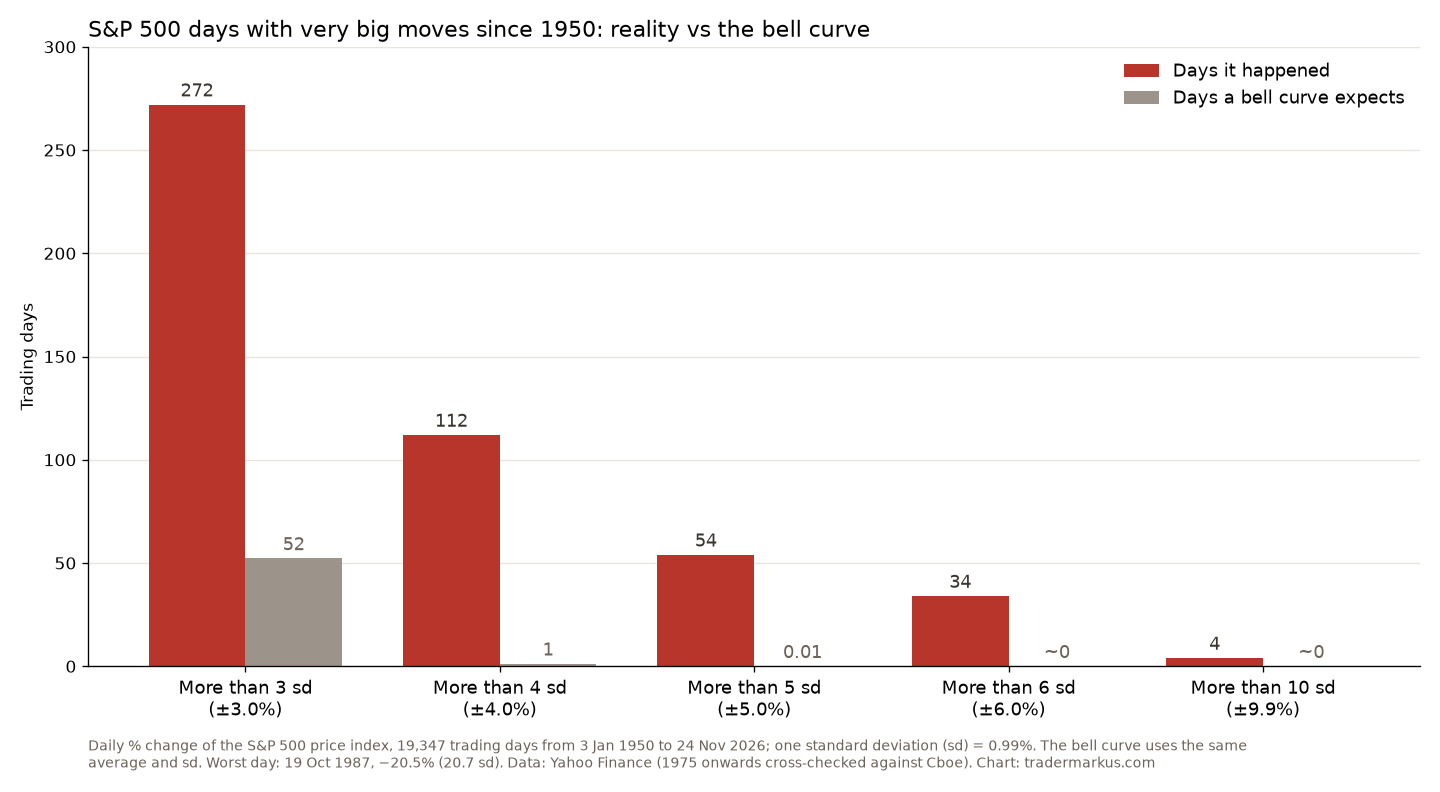
The bell curve expects about one day beyond 4 standard deviations in those 77 years. There were 112. A move of 5 standard deviations, about 5% in a day, should happen once every 6,900 years or so. The S&P 500 had 54 of them. A 10-standard-deviation day shouldn’t happen in the lifetime of the universe, and there were 4. The worst, 19 October 1987, was a 20.5% fall, 20.7 standard deviations. The best was 13 October 2008, up 11.6%. The ten worst days, and what was going on each time, are in my black swan event post.
That comparison is even generous to the bell curve. I measured the standard deviation on the whole period, crashes included, which nobody could have done in 1986. A risk model fitted on calm years would have been more surprised still.
This is what Taleb means by the turkey. The turkey is fed every day for a thousand days, and every day its confidence in the farmer grows, right up to the day before Thanksgiving. A risk model fitted on a quiet decade is the turkey. It is most confident just before the day that breaks it.
Not financial advice. This is educational content, shared for information and entertainment only, and it is not a recommendation to buy or sell any asset. Backtests and past results do not guarantee future results, and the numbers or charts here may contain mistakes. Trading carries risk, including losing all the money you put in. Do your own research before you make any decision.
The ludic fallacy and my own backtests
Taleb’s name for the error behind those models is the ludic fallacy: treating real life like a casino game, where the odds are known and the dice have six sides. In a casino the worst case is known in advance. In a market it isn’t.
This is the part of the book that bites a trader like me. A backtest is a casino game built from the past. It knows only the days that already happened, and the worst drawdown in it is only the worst one so far. That’s why I size positions so that a day worse than anything in the test doesn’t end the account, and why I keep repeating the old line that your worst drawdown is yet to come. The S&P 500’s own drawdown history makes the same point: its fall of 2007–09 was the deepest since 1950, and nothing in the data from 1950 to 2007 said it would be.
It also makes me careful with strategies that win small and often. Selling options is the classic case: steady small gains, and some of them handed back in the bad months. I found that pattern when I tested the iron condor. In Taleb’s language, a trade like that is fragile: it earns a little from calm markets and loses a lot in the rare day it wasn’t built for.
Where I disagree
The book is long and rambling, and Taleb’s tone gets in the way. He spends a lot of pages attacking forecasters, financial modellers and what he calls nerds, and some readers will give up before the useful chapters. The Guardian’s reviewer in 2007 liked the ideas but called the style a central problem. I agree with both halves of that.
I also think he goes too far on prediction. He is right that nobody can predict the next crash. But a trader doesn’t need to. I don’t forecast; I read the chart, put a stop where the trade is wrong, and size from that. That is my own small version of what he recommends: limit the damage from the surprises you can’t predict and stay exposed to the good ones.
His own answer for investors is the barbell: most of the money in the safest assets you can find, a small part in very speculative bets, and nothing in the middle. It is a clean idea, but it’s an investor’s portfolio, not a trading method, and the book doesn’t help much with the day-to-day.
Is The Black Swan worth reading?
Yes, if you trade or manage money, but read it for the ideas, not the style. Mediocristan, Extremistan and the turkey are ideas I use all the time, and the S&P 500’s history shows he is right about the tails. If you only want one Taleb book, start with Fooled by Randomness, which is closer to trading. Daniel Kahneman, whose Thinking, Fast and Slow I also reviewed, wrote that The Black Swan changed his view of how the world works.
My verdict: an important book wrapped in a difficult one. It won’t give you a strategy. It will make you ask of every strategy what happens on the day that isn’t in the data, and for a trader that question is worth more than any indicator.
Affiliate link: as an Amazon Associate I earn from qualifying purchases. It doesn’t change the verdict.