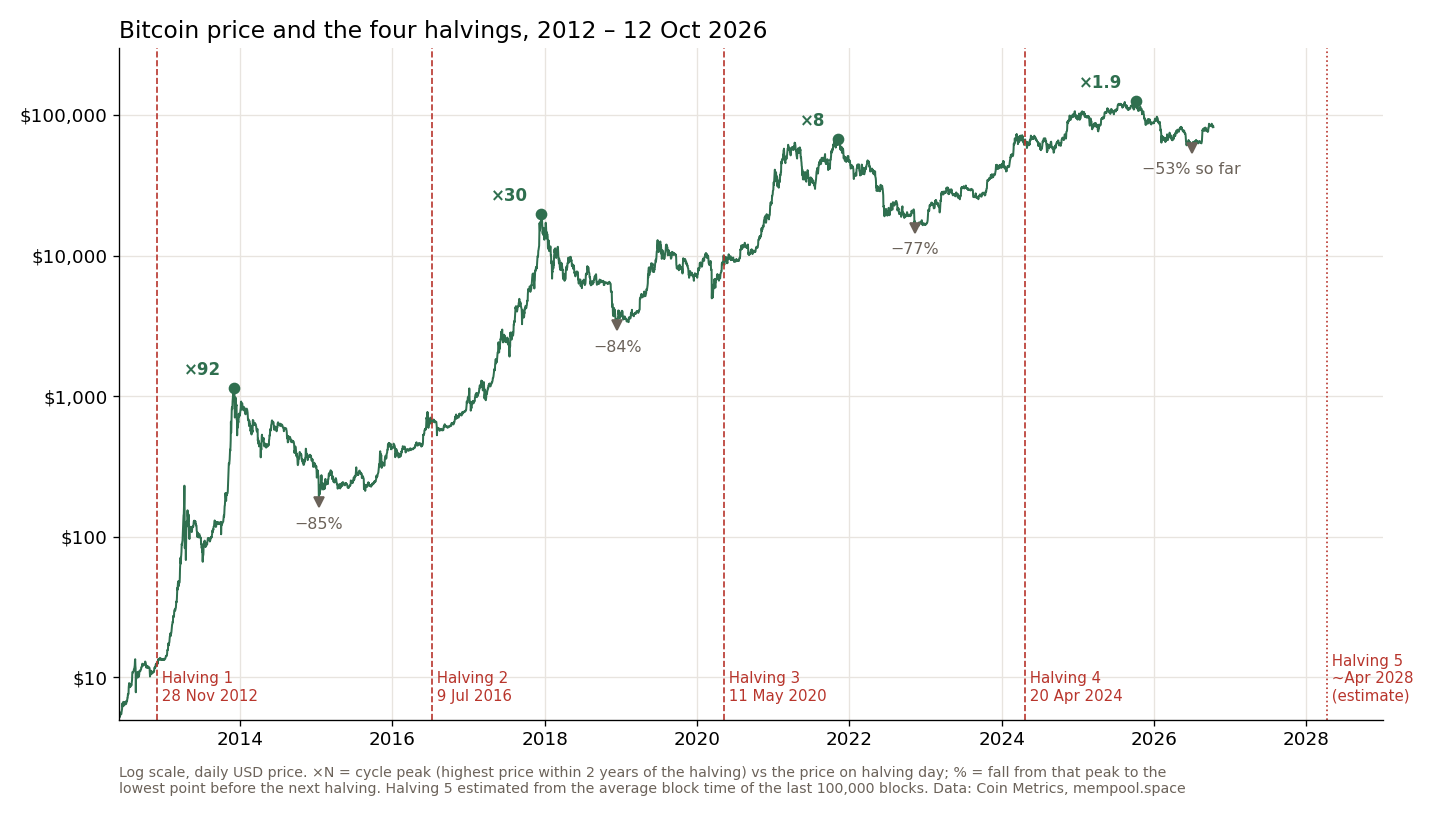
Bitcoin has had four halvings: 28 November 2012, 9 July 2016, 11 May 2020 and 20 April 2024. After each one the price peaked 371 to 546 days later. The first three peaks were followed by falls of 77% to 85%; the latest is down 53% so far. The timing has repeated four times. The size hasn’t: the peak was 92 times the halving-day price after the first halving, 30 times after the second, 8 times after the third and 1.9 times after the fourth. The next halving should come around April 2028.
What is the Bitcoin halving?
Bitcoin miners are paid in new coins for every block they add. Every 210,000 blocks, that reward is cut in half. That’s the halving. It started at 50 bitcoins per block in 2009, dropped to 25 in 2012, 12.5 in 2016, 6.25 in 2020 and 3.125 in April 2024. The rule is in the code, so the halving happens at a block height, not on a calendar date. Blocks come about every ten minutes on average, which puts the halvings roughly four years apart.
The story traders tell is simple: half the new supply, same demand, price goes up. The four cycles since 2012 are the reason that story is so popular.
Bitcoin halving dates: 2012, 2016, 2020, 2024
I took the exact block times from two block explorers, mempool.space and Blockstream, which agree to the second. Prices are daily from the Coin Metrics community data, which goes back to 2010. On the 4,405 days where it overlaps with Yahoo Finance, the two differ by a median of 0.15%.
| Halving | Block | Price |
|---|---|---|
| 28 Nov 2012 | 210,000 | $12.33 |
| 9 Jul 2016 | 420,000 | $651.94 |
| 11 May 2020 | 630,000 | $8,592 |
| 20 Apr 2024 | 840,000 | $64,908 |
What happened to the price after each halving?
For each cycle I took the highest daily price within two years of the halving, and then the lowest price after that peak before the next halving.
| Halving | Peak | Fall after |
|---|---|---|
| 2012 | Dec 2013, ×92 (371 days) |
−84.5% |
| 2016 | Dec 2017, ×30 (525 days) |
−83.8% |
| 2020 | Nov 2021, ×7.9 (546 days) |
−76.7% |
| 2024 | Oct 2025, ×1.9 (534 days) |
−53.1% so far |
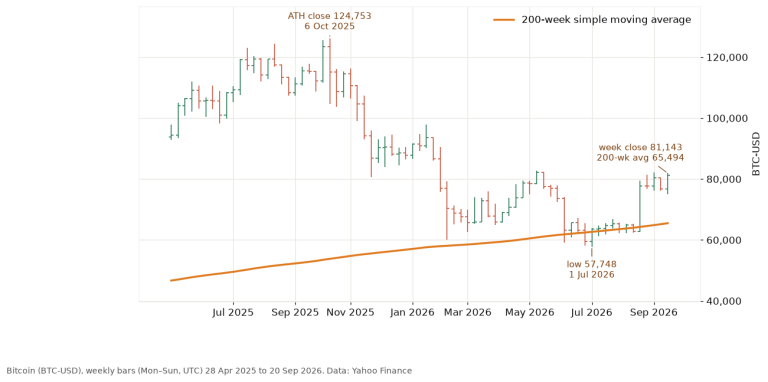
The 2024 cycle peaked at $124,824 on 6 October 2025, 534 days after the halving – right in the window of the earlier ones. The lowest close since then was $58,525 on 30 June 2026. On 12 October 2026 Bitcoin was at $81,805, 34% below the peak and 26% above the halving-day price.
Is the 4-year cycle still working?
The timing, so far, yes. Four peaks landed between 12 and 18 months after a halving, and the falls that followed lasted about a year: the earlier lows came 777, 889 and 912 days after their halvings. That regularity is the strongest argument for the cycle.
The payoff is the weak part. Each peak paid less: ×92, ×30, ×7.9, ×1.9. Each fall was a bit shallower too, from −84.5% to −53.1% so far. Bitcoin is a much bigger market than in 2012, with ETFs, futures and institutions, and the newly mined coins matter less every cycle – after April 2024 it’s 3.125 coins per block on top of more than 20 million already mined. If the halving was ever the main driver, it is a smaller one every time. Four cycles is also a very small sample. I wouldn’t bet a portfolio on a pattern I’ve seen four times.
When is the next Bitcoin halving?
At block 1,050,000. On 13 October 2026 the chain was at block 971,188, so 78,812 blocks to go. Over the last 100,000 blocks the average time per block was 597.6 seconds, a little under ten minutes. At that pace the fifth halving lands around 10 April 2028. Treat it as an estimate: block times change with mining power, and the date can move by weeks. The reward then drops to 1.5625 bitcoins per block.
Bitcoin halving price prediction: what I actually do with it
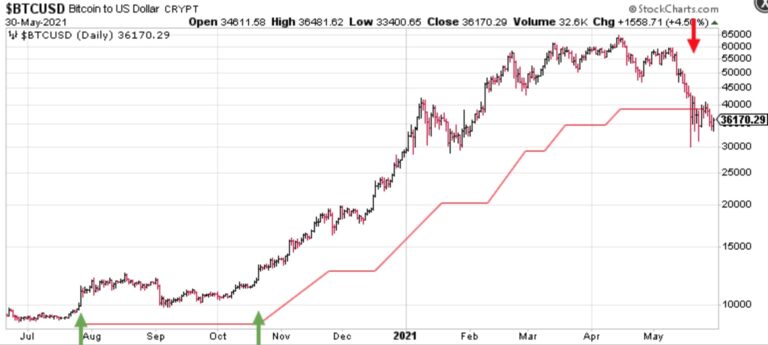
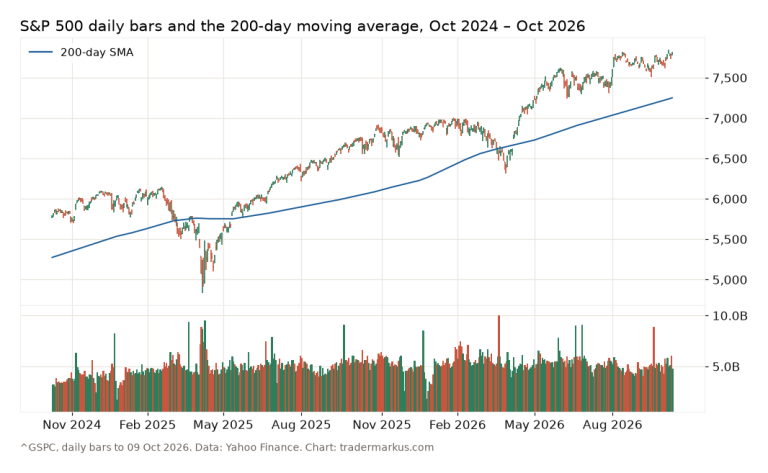
I don’t trade the halving date. Nobody can tell you the next peak from four data points with shrinking returns, and anyone who gives you a number for 2029 is guessing. What the cycle does give me is a sense of the risk: in every cycle so far, Bitcoin fell more than 50% from its peak. If I hold Bitcoin I size the position as if a 50–80% drop can happen again, because it has every time. For the trend itself I’d rather watch the price than the calendar – the 200-week moving average and the 200-day line say more about where Bitcoin is than the block count does. My 20-day breakout test on Bitcoin shows how brutal those falls are for a trend follower, and the current levels I watch are on the weekly levels page.
FAQ
What is the Bitcoin halving in simple terms?
The number of new bitcoins created with each block is cut in half every 210,000 blocks, about every four years. It slows the growth of supply. It doesn’t change the coins that already exist.
How many Bitcoin halvings have there been?
Four: in 2012, 2016, 2020 and 2024. The next one is expected around April 2028, and they continue until the reward rounds down to zero.
Does the price always go up after a halving?
So far, yes, within a year and a half – but by less each time, and every peak was followed by a fall of more than 50%. A year after the April 2024 halving, Bitcoin was 31% higher; the peak came later, in October 2025.
The halving is the most reliable date in crypto. What the price does around it has been reliable four times and smaller each time. Respect the drawdowns, not the date.
Not financial advice. This is educational content, shared for information and entertainment only, and it is not a recommendation to buy or sell any asset. Backtests and past results do not guarantee future results, and the numbers or charts here may contain mistakes. Trading carries risk, including losing all the money you put in. Do your own research before you make any decision.