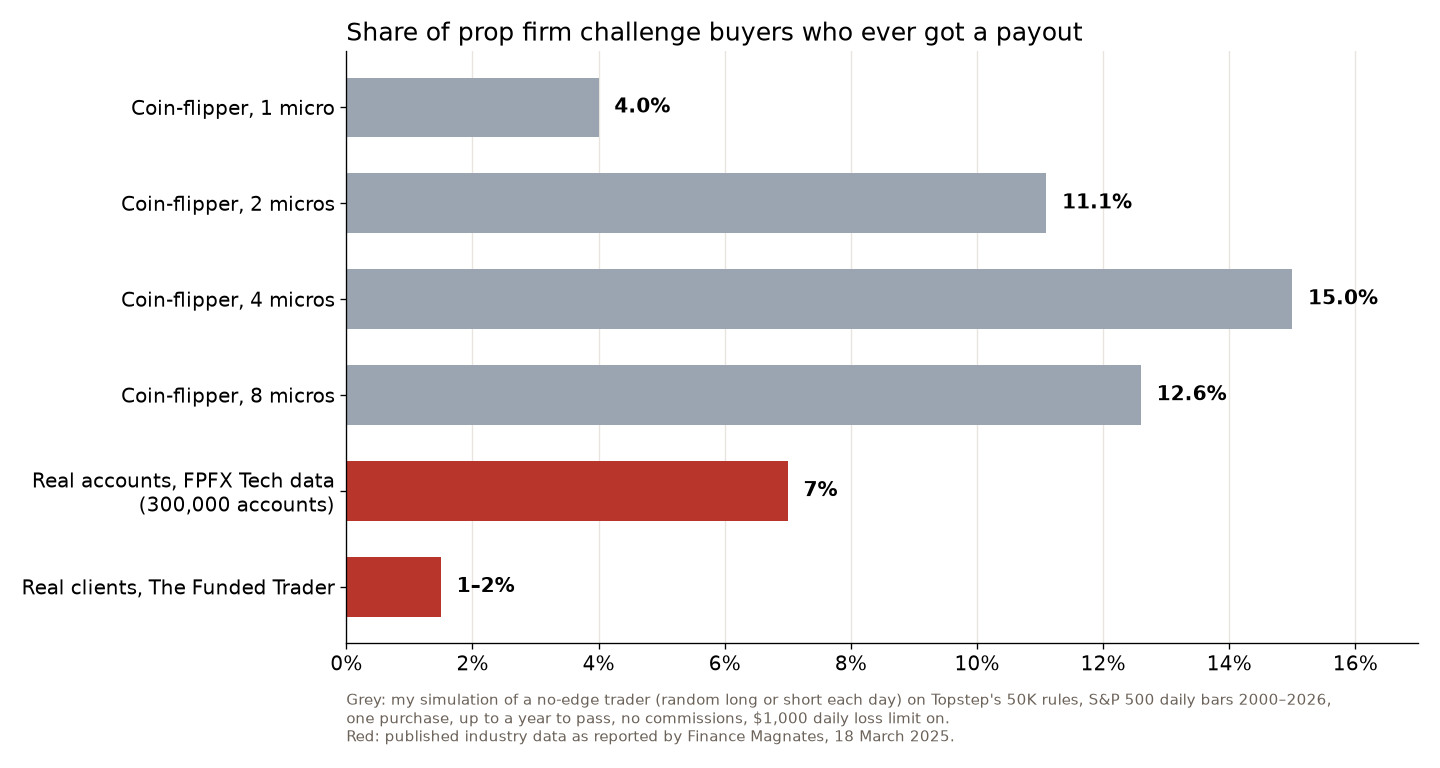
Prop firms make most of their money from challenge fees, not from trading. At Topstep, even the funded account you earn by passing is simulated – the firm pays you real money based on simulated results. I ran a trader with no edge at all, a coin-flipper, through Topstep’s $50K rules on 26 years of S&P 500 data. It got paid on 15% of challenge purchases. Published industry data says about 7% of real accounts ever get a payout.
How do prop firms make money?
A retail prop firm sells you an evaluation. You pay a monthly fee, trade a demo account under strict rules, and if you hit the profit target without breaking the loss limits, you get a funded account and a share of the profits you make there. At Topstep the 50K Trading Combine costs $49 a month on the standard path, a reset after a blown account costs another $49, and passing costs a $149 activation fee for the funded account.
The part most people miss is what that funded account is. Topstep’s own help page calls the Express Funded Account “the simulated funded-level account you earn after passing”, and says Topstep “pays you real money based on your simulated trading results.” Topstep also has a Live Funded Account further up the ladder, but the account you get for passing is the simulated one. So a payout from it is not your cut of real trading profits. My reading: it is paid out of the firm’s income, and the firm’s income is mostly the fees of everyone who tries. The firm doesn’t need its customers to lose money in the market. It needs most of them to fail the rules.
One firm said so openly. In March 2025 the CEO of The Funded Trader, Angelo Ciaramello, told Finance Magnates that 5–10% of its customers passed the challenge and about 20% of those got paid, so 1–2% of all clients. In the same article, data from FPFX Tech on 300,000 prop accounts showed that 7% ever reached a payout.
The rules of a $50K prop firm challenge
I used Topstep’s published rules for the 50K account, as they stood on 12 October 2026. Other firms use similar numbers with different names.
| Rule | 50K Combine |
|---|---|
| Profit target | $3,000 |
| Maximum loss | $2,000, trailing |
| Daily loss limit | $1,000 (optional) |
| Best day | Max 55% of profit |
| Price | $49 a month |
The rule that does the work is the Maximum Loss Limit. It starts $2,000 below your starting balance and moves up with your end-of-day balance, until it reaches the starting balance and locks there. It counts open losses too, in real time. Make $1,500, give it back, and you are now $500 from losing the account instead of $2,000. The consistency rule adds that your best day can’t be more than 55% of your total profit, or the target goes up.
I gave the $50K challenge to a coin-flipper
To see what the rules do on their own, I took the edge out completely. Every day my simulated trader flips a coin, goes long or short the S&P 500 with a fixed number of Micro E-mini contracts ($5 a point at CME), and holds from one close to the next. I used real daily S&P 500 bars from 2000 to October 2026, checked the day’s low or high against the loss limits, started each run on a random day and repeated it 20,000 times per size. No commissions or slippage, which flatters the coin-flipper.
| Size | Passed | Paid | Fee/payout |
|---|---|---|---|
| 1 | 6.1% | 4.0% | $542/$35 |
| 2 | 16.6% | 11.1% | $376/$86 |
| 4 | 25.4% | 15.0% | $200/$146 |
| 8 | 27.1% | 12.6% | $112/$203 |
Size is the number of Micro E-mini contracts. One purchase per run, up to a year to pass, the optional $1,000 daily loss limit switched on; fees and payouts are averages per buyer. The small coin-flipper rarely loses the account, but it rarely reaches $3,000 either, and it keeps paying $49 a month while it drifts. The bigger ones settle fast in either direction. At 4 micros, about one buyer in four passed and roughly one in seven got paid at least once. With resets allowed, the same coin-flipper passed within three years 97% of the time, at a median cost of $541 including the activation fee.
In the funded account the coin-flipper’s luck runs out quickly. Starting from a $0 balance with the same $2,000 trailing limit, the 4-micro version lasted a median 24 trading days. Payouts need five winning days of $150 or more, and the payout policy lets you take 50% of the balance, up to $2,000 a request on a 50K account, with a 90/10 split.
Why real traders do worse than a coin flip
Here is the uncomfortable part. A trader with no edge got paid on 13–15% of purchases at 4 to 8 micros. Real accounts in the FPFX data got paid 7% of the time, and The Funded Trader reported 1–2% of its clients. Topstep’s own payout page says “63% of Traders lost their Combine on day 1.” My coin-flipper never lost on day one with the daily loss limit on, and only 5.7% of the time at 8 micros without it. However you read Topstep’s figure, losing the account on the first day takes more than bad luck.
I can’t prove why from the outside, but I know the usual suspects from my own early years. Too many contracts for a $2,000 limit. Many trades a day instead of one, each paying commission. Doubling down after a loss to get back above the trailing line, which is FOMO with a deadline. And moving the stop because the account “can’t” lose another $300. The rules are built so that exactly those habits end the account, and the fee is already paid.
Are prop firms worth it?
As a way to find out whether you can trade, no. A coin can pass a challenge, so passing tells you little, and failing costs you money each month. As cheap access to leverage for someone who already has a tested method and trades small, maybe. If your plan risks 0.5% of the $50,000 per trade, $250, with a real stop loss on every position, the $2,000 limit is eight losing trades in a row away. If you need luck to pass, you are the customer the business is built on. I wrote about the same line between a plan and a bet in is day trading gambling?
FAQ
Do prop firms pay real money?
Yes. Topstep says it pays real money based on results in a simulated account, with a minimum payout of $125 and a 90/10 profit split. The question is how many traders ever qualify: about 7% of accounts in the FPFX data.
How much does a $50,000 funded account cost?
At Topstep, $49 a month for the 50K Combine on the standard path, $49 per reset and a $149 activation fee when you pass (or $95 a month with no activation fee). In my simulation a no-edge trader with 4 micros spent a median $541 to get funded, activation fee included.
What are the disadvantages of prop firms?
A trailing loss limit that punishes giving back profit, payout caps, a funded account that is simulated, and rules the firm can change. You also don’t own the account – break a rule and it’s gone, along with the fees you paid to get there.
A prop firm challenge is a fair game only if you bring an edge to it. Without one, the math works for the firm, and that is how they make money.
Not financial advice. This is educational content, shared for information and entertainment only, and it is not a recommendation to buy or sell any asset. Backtests and past results do not guarantee future results, and the numbers or charts here may contain mistakes. Trading carries risk, including losing all the money you put in. Do your own research before you make any decision.